 |
TSDuck v3.46-4867
MPEG Transport Stream Toolkit
|
|
TSDuck v3.46-4867
MPEG Transport Stream Toolkit
|
SSL/TLS connected socket for use in a Reactor environment. More...
#include <tsReactiveTLSConnection.h>
Public Member Functions | |
| ReactiveTLSConnection (Reactor &reactor, TCPConnection &socket) | |
| Constructor. | |
| ReactiveTLSConnection (Reactor &reactor, TCPConnection &socket, const TLSArgs &args) | |
| Constructor with initial client arguments. | |
| const UStringList & | additionalServerNames () const |
| For a client connection, get all addition host names for the server's certificate verification during connect(). | |
| void | addSubscription (SubscriptionHandlerInterface *handler) |
| Add a subscriber to open/close events. | |
| void | addVerifyServer (const UString &name) |
| For a client connection, add another accepted host name for the server's certificate verification during connect(). | |
| virtual void | cancelReadWriteStream (bool silent=false) override |
| Cancel any pending read or write operation on this stream. | |
| void | cancelSubscription (SubscriptionHandlerInterface *handler) |
| Remove a subscriber to open/close events. | |
| Device & | device () |
| Get a reference to the associated non-blocking device. | |
| bool | isOpen () const |
| Check if the reactive socket is open. | |
| bool | muteReport (bool mute) |
| Temporarily mute the associated report. | |
| Reactor & | reactor () |
| Get a reference to the associated reactor. | |
| virtual Report & | report () const override |
| Access the Report which is associated with this object. | |
| const UString & | serverName () const |
| For a client connection, get the server name to be used in SNI (Server Name Indication). | |
| void | setArgs (const TLSArgs &args) |
| Set command line arguments for the client. | |
| Report * | setReport (Report *report) |
| Associate this object with another Report to log errors. | |
| ReporterBase * | setReport (ReporterBase *delegate) |
| Associate this object with another ReporterBase to log errors. | |
| void | setServerName (const UString &server_name) |
| For a client connection, specify the server name to be used in SNI (Server Name Indication). | |
| void | setVerifyPeer (bool on) |
| Define if the peer's certificate shall be verified. | |
| bool | signalQueuedOperations () |
| Trigger the execution of processQueuedOperations() in the context of a Reactor handler. | |
| TCPConnection & | socket () |
| Get a reference to the associated socket. | |
| virtual bool | startClose (ReactiveTCPConnectionHandlerInterface *handler, bool silent=false, const ObjectPtr &user_data=ObjectPtr()) override |
| Start closing the socket. | |
| virtual bool | startCloseWriter (ReactiveStreamHandlerInterface *handler, bool silent=false, const ObjectPtr &user_data=ObjectPtr()) override |
| Start closing the send direction of the socket. | |
| virtual bool | startConnect (ReactiveTCPConnectionHandlerInterface *handler, const IPSocketAddress &addr, const ObjectPtr &user_data=ObjectPtr()) override |
| Start the operation of connecting to a TCP server. | |
| virtual bool | startReadStream (ReactiveStreamHandlerInterface *handler, size_t buffer_size=Device::DEFAULT_RECEIVE_BUFFER_SIZE, const ObjectPtr &user_data=ObjectPtr()) override |
| Start the operation of reading data from the stream. | |
| virtual bool | startWriteStream (ReactiveStreamHandlerInterface *handler, const void *data, size_t size, const ObjectPtr &user_data=ObjectPtr()) override |
| Start the operation of writing data to the stream. | |
| StreamInterface & | stream () |
| Get a reference to the associated stream. | |
| bool | verifyPeer () const |
| Check if the peer's certificate shall be verified. | |
| virtual void | whenAccepted (ReactiveTCPConnectionHandlerInterface *handler, const ObjectPtr &user_data=ObjectPtr()) override |
| Define the handler to call when accepted as a client session by a TCP server. | |
Static Public Member Functions | |
| static int | SilentLevel (bool silent, int default_severity=Severity::Error) |
| Compute a log severity level from a "silent" parameter. | |
Protected Types | |
| using | HandlerType = ReactiveTCPConnectionHandlerInterface |
| Shorter name for handler type. | |
| using | IOQueue = std::list< std::shared_ptr< IOSB > > |
| Queues of I/O requests are queues of shared_ptr to IOSB. | |
| using | IOSB = Device::IOSB |
| IOSB shortcut fpr subclasses. | |
| using | IOSet = std::set< std::shared_ptr< IOSB > > |
| Unordered set of I/O requests, set of shared_ptr to IOSB. | |
Protected Member Functions | |
| bool | activateAsynchronousIO () |
| Activate notification for asynchronous I/O. | |
| bool | activateReadReady () |
| Activate read-ready notification for immediate I/O. | |
| bool | activateWriteReady () |
| Activate write-ready notification for immediate I/O. | |
| template<typename HANDLER , typename F > requires std::derived_from<HANDLER, SubscriptionHandlerInterface> | |
| void | callSubscribers (F &&func) |
| Call a handler on all subscribers, using a lambda expression. | |
| bool | cancelAndWaitAsynchronousIO (Device::IOSB &iosb, bool silent) |
| Cancel one specific pending asynchronous I/O and wait for its completion. | |
| void | cancelAsynchronousIO (bool silent) |
| Cancel all asynchronous I/O in progress. | |
| template<class REQUEST > requires std::derived_from<REQUEST, ts::Object> | |
| void | cancelQueue (IOQueue &inqueue, IOQueue &outqueue) |
| Transfer all requests from one queue to another and mark all I/O as canceled. | |
| bool | createSignalQueuedOperations () |
| Create, if necessary, the dedicated user event for signalQueuedOperations(). | |
| void | deactivateAll (bool silent) |
| Deactivate all registrations for immediate and asynchronous I/O. | |
| void | deactivateAsynchronousIO (bool silent) |
| Deactivate notification for asynchronous I/O. | |
| void | deactivateQueuedOperations (bool silent) |
| Deactivate the execution of processQueuedOperations() in the context of a Reactor handler. | |
| void | deactivateReadReady (bool silent) |
| Deactivate read-ready notification for immediate I/O. | |
| void | deactivateWriteReady (bool silent) |
| Deactivate write-ready notification for immediate I/O. | |
| bool | enqueueCompletedIO (const std::shared_ptr< IOSB > &iosb, bool in_reactor) |
| Enqueue an IOSB in the completed I/O queue. | |
| virtual void | handleAsynchronousIO (Reactor &, EventId, IOSB &, size_t) override |
| Handle an asynchronous I/O completion event in a Reactor. | |
| virtual void | handleBroadcastEvent (Reactor &reactor, int error_code, const ObjectPtr &user_data) |
| Handle a broadcast event in a Reactor. | |
| virtual void | handleProcessTermination (Reactor &reactor, EventId id, int pid) |
| Handle a process termination event in a Reactor. | |
| virtual void | handleReadReady (Reactor &, EventId, int) override |
| Handle a read-ready event in a Reactor. | |
| virtual void | handleReadStream (ReactiveStream &stream, const ByteBlockPtr &data, ReactiveInputControl &control, int error_code, const ObjectPtr &user_data) override |
| Handle the reception of data from a read operation on a stream. | |
| virtual void | handleTCPAccepted (ReactiveTCPServer &server, ReactiveTCPConnection &sock, int error_code, const ObjectPtr &user_data) override |
| Handle the completion of a client connection of a TCP socket in the context of a server. | |
| virtual void | handleTCPClosed (ReactiveTCPConnection &sock, const ObjectPtr &user_data) override |
| Handle the completion of closing a TCP socket. | |
| virtual void | handleTCPConnected (ReactiveTCPConnection &sock, int error_code, const ObjectPtr &user_data) override |
| Handle the completion of a connection of a TCP socket. | |
| virtual void | handleTimer (Reactor &reactor, EventId id) |
| Handle a timer in a Reactor. | |
| virtual void | handleUserEvent (Reactor &, EventId) override |
| Handle a user-defined event in a Reactor. | |
| virtual void | handleWriteReady (Reactor &, EventId, int) override |
| Handle a write-ready event in a Reactor. | |
| virtual void | handleWriteStream (ReactiveStream &stream, int error_code, const ObjectPtr &user_data) override |
| Handle the completion of a write operation on a stream. | |
| virtual bool | hasPendingIO () |
| Check if some I/O operations are in progress. | |
| virtual bool | needsWriteReady () |
| With immediate I/O, check if we need to be notified of write-ready conditions. | |
| virtual int | processCloseWriteStream (bool silent) override |
| Implement the close of the write direction of the stream. | |
| virtual void | processQueuedOperations () override |
| This virtual method processes operations in the context of a Reactor handler. | |
| void | processReceiveBuffer (ByteBlockPtr &data, ReactiveInputControl &control, ReactiveStreamHandlerInterface *handler, int error_code, const ObjectPtr &user_data) |
| Invoke the receive handler as many times as possible on a data buffer. | |
| std::shared_ptr< IOSB > | removeFromQueue (IOQueue &queue, IOSB *iosb) |
| Search and remove a shared_ptr to IOSB, based on an IOSB address. | |
| virtual bool | startCloseWriteStream (ReactiveStreamHandlerInterface *handler, bool silent, const ObjectPtr &user_data) |
| Start closing the write direction of the stream. | |
| virtual bool | tryCompletedIO (const std::shared_ptr< IOSB > &iosb) override |
| Try to interpret an IOSB as a valid completed I/O request and process the completion. | |
| bool | uncheckedSignalQueuedOperations () |
| Trigger the execution of processQueuedOperations() from another thread. | |
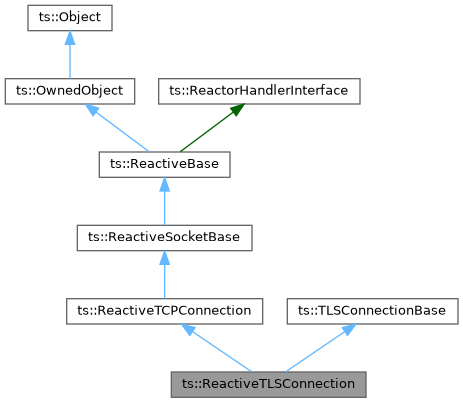
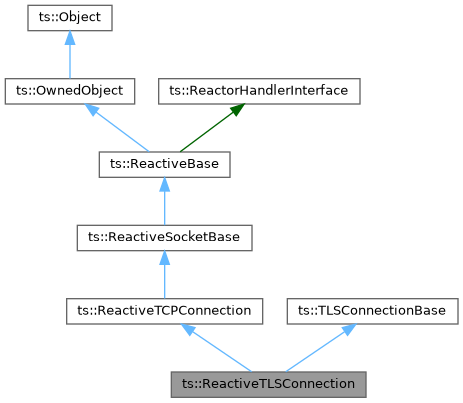
SSL/TLS connected socket for use in a Reactor environment.
The class ReactiveTLSConnection is a wrapper around TCPConnection to handle reactive I/O.
The actual socket is a separate object. It is initialized and configured by the application. The application shall not directly call connect(), send(), receive(), closeWriter(), or close() on this socket and delegate these operations to startConnect(), startSend(), startReceive(), startCloseWriter() and startClose() in class ReactiveTLSConnection.
|
protectedinherited |
Queues of I/O requests are queues of shared_ptr to IOSB.
This is typically used with immediate I/O where we must process requests in order. Send and receive requests are structures which are stored in the react_data of the IOSB.
|
protectedinherited |
Unordered set of I/O requests, set of shared_ptr to IOSB.
This is typically used with asynchronous I/O. The ordering is enforced because I/O are started in order of calls from applications. The completion processing is likely the same, but driven by the system I/O Completion Ports and we must not assume any order. Send and receive requests are structures which are stored in the react_data of the IOSB.
| ts::ReactiveTLSConnection::ReactiveTLSConnection | ( | Reactor & | reactor, |
| TCPConnection & | socket | ||
| ) |
Constructor.
| [in,out] | reactor | Associated reactor. The reactor object must remain valid as long as this object is valid. |
| [in,out] | socket | Associated socket. The socket object must remain valid as long as this object is valid. The ReactiveTLSConnection must be initialized before the socket is opened. Important: socket must be an instance of TCPConnection, not an instance of TLSConnection. |
| ts::ReactiveTLSConnection::ReactiveTLSConnection | ( | Reactor & | reactor, |
| TCPConnection & | socket, | ||
| const TLSArgs & | args | ||
| ) |
Constructor with initial client arguments.
| [in,out] | reactor | Associated reactor. The reactor object must remain valid as long as this object is valid. |
| [in,out] | socket | Associated socket. The socket object must remain valid as long as this object is valid. The ReactiveTLSConnection must be initialized before the socket is opened. Important: socket must be an instance of TCPConnection, not an instance of TLSConnection. |
| [in] | args | Initial TLS client arguments. |
|
overridevirtual |
Start the operation of connecting to a TCP server.
| [in] | handler | Handler class to call when the connect operation completes. The method handleTCPConnected() will be called. If nullptr, no handler is called. |
| [in] | addr | IP address and port of the server to connect to. |
| [in] | user_data | A shared pointer which will be passed unmodified to handler. |
Reimplemented from ts::ReactiveTCPConnection.
|
overridevirtual |
Define the handler to call when accepted as a client session by a TCP server.
Typically called from the constructor of an enclosing object which is used as client session context.
| [in] | handler | Handler class to call when this object is connected to a remote client by a server. The method handleTCPAccepted() will be called. If nullptr, no handler is called. |
| [in] | user_data | A shared pointer which will be passed unmodified to handler. |
Reimplemented from ts::ReactiveTCPConnection.
|
overridevirtual |
Start the operation of reading data from the stream.
Reading operation is permanent and handler is called whenever incoming data are available.
| [in] | handler | Handler class to call each time data are received. The method handleReadStream() will be called for each new chunk of data. Cannot be null. If a previous receive handler was registered, it is replaced. |
| [in] | buffer_size | Size of input buffers to receive data. |
| [in] | user_data | A shared pointer which will be passed unmodified to handler. |
Reimplemented from ts::ReactiveStream.
|
overridevirtual |
Start the operation of writing data to the stream.
| [in] | handler | Handler class to call when the send operation completes. The method handleWriteStream() will be called. If nullptr, no handler is called. |
| [in] | data | Address of the data to write. The corresponding memory area must remain valid until the completion or cancelation of the send operation. |
| [in] | size | Size in bytes of the data to send. |
| [in] | user_data | A shared pointer which will be passed unmodified to handler. |
Reimplemented from ts::ReactiveStream.
|
overridevirtual |
Cancel any pending read or write operation on this stream.
If a repeated read operation is in progress, the repetition is canceled as well.
| [in] | silent | If true, do not report errors through the logger. |
Reimplemented from ts::ReactiveStream.
|
overridevirtual |
Start closing the send direction of the socket.
The peer will receive an end-of-file condition. All pending send operations are guaranteed to complete before that end-of-file is sent.
| [in] | handler | Handler class to call when the close-writer operation completes. The method handleWriteStream() will be called with its parameter error_code containing SYS_EOF. If nullptr, no handler is called. |
| [in] | silent | If true, do not report errors through the logger. |
| [in] | user_data | A shared pointer which will be passed unmodified to handler. |
Reimplemented from ts::ReactiveTCPConnection.
|
overridevirtual |
Start closing the socket.
Pending asynchronous operations are canceled. The actual cancelation will take place later. In the meantime, the user's data buffers for these pending operations are busy and shall not be destroyed / deallocated by the application. The close operation terminates when the handler handleTCPClosed() is invoked. At this point, no more operation is pending and the application may get rid of data buffers.
Note that the application, usually inside a handler, can call disconnect() on the TCPConnection object. Only closeWriter() and close() shall not be called and replaced by startCloseWriter() and startClose() on the ReactiveTCPConnection object.
| [in] | handler | Handler class to call when the close operation completes. The method handleTCPClosed() will be called. If nullptr, no handler is called. |
| [in] | silent | If true, do not report errors through the logger. |
| [in] | user_data | A shared pointer which will be passed unmodified to handler. |
Reimplemented from ts::ReactiveTCPConnection.
|
overrideprotectedvirtual |
This virtual method processes operations in the context of a Reactor handler.
This is dedicated to operations which must be serialized from an application perspective. These operations are typically queued when triggered from a method which is called by the application. When the reactor processes events, we are sure that the application is not executing a handler. The default implementation does nothing. A subclass should override it if it calls signalQueuedOperations().
Reimplemented from ts::ReactiveTCPConnection.
|
overrideprotectedvirtual |
Handle the completion of a connection of a TCP socket.
| [in,out] | sock | TCP socket for which the handler is invoked. |
| [in] | error_code | System-specific error code, SYS_SUCCESS on success, SYS_ERROR in case of unknown error, SYS_CANCELED if the connection was canceled before completion. |
| [in] | user_data | The user-data shared pointer which was passed to startConnect(). |
Reimplemented from ts::ReactiveTCPConnectionHandlerInterface.
|
overrideprotectedvirtual |
Handle the completion of a client connection of a TCP socket in the context of a server.
| [in,out] | server | TCP server in the context of which sock is starting a new client session. |
| [in,out] | sock | TCP socket for which the handler is invoked. |
| [in] | error_code | System-specific error code, SYS_SUCCESS on success, SYS_ERROR in case of unknown error. |
| [in] | user_data | The user-data shared pointer which was passed to whenAccepted(). |
Reimplemented from ts::ReactiveTCPConnectionHandlerInterface.
|
overrideprotectedvirtual |
Handle the completion of closing a TCP socket.
An application closes a ReactiveTCPConnection using startClose() and this handler is called when the closing of the socket is complete. This is specifically important on operating systems with asynchronous I/O such as Windows. The application shall not call TCPSocket::close() and immediately consider the socket as done. If there are pending asynchronous I/O, the associated data buffers are still in use, until the cancelation of the these I/O are completed, after closing the socket. The application shall therefore wait for the handleTCPClosed() handler to destroy the data buffers and consider the socket as completely done.
| [in,out] | sock | TCP socket for which the handler is invoked. |
| [in] | user_data | The user-data shared pointer which was passed to startClose(). |
Reimplemented from ts::ReactiveTCPConnectionHandlerInterface.
|
overrideprotectedvirtual |
Handle the completion of a write operation on a stream.
| [in,out] | stream | Stream device for which the handler is invoked. |
| [in] | error_code | System-specific error code, including:
|
| [in] | user_data | The user-data shared pointer which was passed to startWriteStream(). |
Reimplemented from ts::ReactiveStreamHandlerInterface.
|
overrideprotectedvirtual |
Handle the reception of data from a read operation on a stream.
| [in,out] | stream | Stream device for which the handler is invoked. |
| [in] | data | Shared pointer to the received data. Can be the null pointer in case of error. The handler may safely copy the shared pointer, the pointed data will not be modified by the ReactiveStream. If the returned control specifies that not all input was used, the remaining data in the buffer will be reallocated in a new ByteBlock in the ReactiveStream, after handleReadStream() returns. |
| [in,out] | control | Input control data that the handler may update according to the usage of data. |
| [in] | error_code | System-specific error code, including:
|
| [in] | user_data | The user-data shared pointer which was passed to startReadStream(). |
Reimplemented from ts::ReactiveStreamHandlerInterface.
|
inlineinherited |
Get a reference to the associated socket.
|
inlineinherited |
Check if the reactive socket is open.
This is different from Socket::isOpen() during the closing phase, after startClose() has been called but before the underlying socket is fully closed.
|
overrideprotectedvirtualinherited |
Implement the close of the write direction of the stream.
Must be implemented by subclasses which use startCloseWriteStream(). The default implementation does nothing. This method is always called in the context of a Reactor handler, never as an indirect call from the application.
| [in] | silent | If true, do not report errors through the logger. |
Reimplemented from ts::ReactiveStream.
|
overrideprotectedvirtualinherited |
Try to interpret an IOSB as a valid completed I/O request and process the completion.
If overriden by a subclass, the method must also call its superclass counterpart.
| [in] | iosb | Shared pointer to an IOSB. Specific data can be saved in iosb->react_data. |
Reimplemented from ts::ReactiveStream.
|
overrideprotectedvirtualinherited |
Handle a write-ready event in a Reactor.
This handler is only invoked in the immediate I/O model.
| [in,out] | reactor | Reactor into which the handler is invoked. |
| [in] | id | Id of the event which was signaled. |
| [in] | error_code | System-specific error code, zero on success, SYS_ERROR in case of unknown error. |
Reimplemented from ts::ReactiveStream.
|
overrideprotectedvirtualinherited |
Handle an asynchronous I/O completion event in a Reactor.
This handler is only invoked in the asynchronous I/O model.
| [in,out] | reactor | Reactor into which the handler is invoked. |
| [in] | id | Id of the event which was signaled. |
| [in,out] | iosb | IOSB structure which was used when the asynchronous I/O was started. A system-specific error code is in iosb, SYS_CANCELED if the I/O was canceled before completion. |
| [in] | io_size | Size of the I/O in bytes. |
Reimplemented from ts::ReactiveStream.
|
inlineinherited |
|
protectedvirtualinherited |
Check if some I/O operations are in progress.
|
protectedvirtualinherited |
With immediate I/O, check if we need to be notified of write-ready conditions.
If overriden by a subclass, the method must also call its superclass counterpart.
|
protectedvirtualinherited |
Start closing the write direction of the stream.
The request is enqueued and will be processed by calling processCloseWriteStream() after all previous send requests are completed. This feature can be used by subclasses for which "closing the write direction of the stream" means something (e.g. true for TCP socket, meaningless for files).
| [in] | handler | Handler class to call when the close-writer operation completes. The method handleWriteStream() will be called with its parameter error_code containing SYS_EOF. If nullptr, no handler is called. |
| [in] | silent | If true, do not report errors through the logger. |
| [in] | user_data | A shared pointer which will be passed unmodified to handler. |
|
protectedinherited |
Enqueue an IOSB in the completed I/O queue.
This method can be called by subclasses which need to process specific I/O completion, other than read or write on the stream.
| [in] | iosb | Shared pointer to an IOSB. Specific data can be saved in iosb->react_data. |
| [in] | in_reactor | Set to true if we are in a reactor context, meaning directly called from a reactor handler, not from the application. |
|
protectedinherited |
Invoke the receive handler as many times as possible on a data buffer.
| [in,out] | data | Data buffer containing the received data. On output, data which are processed by the handler are removed. The buffer may be reallocated if all data were processed. |
| [in,out] | control | Input control. On input, this is the previously returned value from the handler. Modified by the handler. |
| [in] | handler | Application handler. |
| [in] | error_code | Receive error code. If not success, the handler is called exactly once. |
| [in] | user_data | User data for the handler. |
|
overrideprotectedvirtualinherited |
Handle a read-ready event in a Reactor.
This handler is only invoked in the immediate I/O model.
| [in,out] | reactor | Reactor into which the handler is invoked. |
| [in] | id | Id of the event which was signaled. |
| [in] | error_code | System-specific error code, zero on success, SYS_ERROR in case of unknown error. |
Reimplemented from ts::ReactorHandlerInterface.
|
inlineinherited |
Get a reference to the associated non-blocking device.
|
protectedinherited |
Search and remove a shared_ptr to IOSB, based on an IOSB address.
Search from the front (end) of the queue since a completed I/O is likely on the front.
| [in,out] | queue | The queue from which to remove iosb. |
| [in] | iosb | Standard pointer to an IOSB to search and remove. |
|
protectedinherited |
Transfer all requests from one queue to another and mark all I/O as canceled.
| REQUEST | The subclass of Object which is set in react_data of all requests in inqueue. |
| [in,out] | inqueue | The queue from which all requests are removed. |
| [in,out] | outqueue | The queue which receives all canceled requests. |
|
protectedinherited |
Activate read-ready notification for immediate I/O.
|
protectedinherited |
Deactivate read-ready notification for immediate I/O.
| [in] | silent | If true, do not report errors through the logger. |
|
protectedinherited |
Activate write-ready notification for immediate I/O.
|
protectedinherited |
Deactivate write-ready notification for immediate I/O.
| [in] | silent | If true, do not report errors through the logger. |
|
protectedinherited |
Activate notification for asynchronous I/O.
|
protectedinherited |
Deactivate notification for asynchronous I/O.
| [in] | silent | If true, do not report errors through the logger. |
|
protectedinherited |
Cancel all asynchronous I/O in progress.
The cancelation occurs in the background and end of canceled asynchronous I/O will be notified.
| [in] | silent | If true, do not report errors through the logger. |
|
protectedinherited |
Cancel one specific pending asynchronous I/O and wait for its completion.
Warning: This is a blocking call. It shall be used in case of trouble only.
| [in,out] | iosb | The asynchronous I/O status block. |
| [in] | silent | If true, do not report errors through the logger. |
|
protectedinherited |
Deactivate all registrations for immediate and asynchronous I/O.
| [in] | silent | If true, do not report errors through the logger. |
|
inlineinherited |
Get a reference to the associated reactor.
|
inherited |
Trigger the execution of processQueuedOperations() in the context of a Reactor handler.
Create if necessary and then signal a dedicated user event.
|
protectedinherited |
Deactivate the execution of processQueuedOperations() in the context of a Reactor handler.
Deactivate and delete the dedicated user event.
| [in] | silent | If true, do not report errors through the logger. |
|
protectedinherited |
Create, if necessary, the dedicated user event for signalQueuedOperations().
Useless if signalQueuedOperations() is used. Only required with use of uncheckedSignalQueuedOperations().
|
protectedinherited |
Trigger the execution of processQueuedOperations() from another thread.
The event must have been previously created, either using createSignalQueuedOperations() or signalQueuedOperations().
|
overrideprotectedvirtualinherited |
Handle a user-defined event in a Reactor.
| [in,out] | reactor | Reactor into which the handler is invoked. |
| [in] | id | Id of the event which was signaled. |
Reimplemented from ts::ReactorHandlerInterface.
|
overridevirtualinherited |
Access the Report which is associated with this object.
Can be called from another thread only if the Report object is thread-safe.
Implements ts::ReporterInterface.
Associate this object with another Report to log errors.
| [in] | report | Where to report errors. The report object must remain valid as long as this object exists or setReport() is used with another Report object. If report is null, log messages are discarded. |
|
inherited |
Associate this object with another ReporterBase to log errors.
| [in] | delegate | Use the report of another ReporterBase. If delegate is null, the previous explicit Report is used.. |
|
inherited |
Temporarily mute the associated report.
| [in] | mute | It true, report() will return a null report (log messages are discarded), until muteReport() is invoked again with mute set to false. |
|
inlinestaticinherited |
Compute a log severity level from a "silent" parameter.
Some subclass methods have a "silent" parameter to avoid reporting errors which may be insignificant, typically when closing a device after an error, in which case the close operation may produce other errors if the previous error left the device in an inconsistent state. While those errors should not be displayed as errors, we still display them at debug level.
| [in] | silent | If true, do not report errors, report debug messages instead. |
| [in] | default_severity | Default severity, in non-silent mode (error by default). |
|
virtualinherited |
Handle a broadcast event in a Reactor.
A broadcast event is sent to all currently registered events in the reactor.
| [in,out] | reactor | Reactor into which the handler is invoked. |
| [in] | error_code | Application-specific error code which was passed to Reactor::signalBroadcastEvent(). |
| [in] | user_data | The user-data shared pointer which was passed to Reactor::signalBroadcastEvent(). |
|
virtualinherited |
Handle a process termination event in a Reactor.
This handler is invoked when the process is no longer there. It is possible that the process was already terminated for a while. It is even possible that the process never really started. There is no portable way to get the process termination status.
| [in,out] | reactor | Reactor into which the handler is invoked. |
| [in] | id | Id of the event which was signaled. |
| [in] | pid | Process id of the terminated process. |
|
inherited |
Add a subscriber to open/close events.
| [in] | handler | The object to call on open() and close(). |
|
inherited |
Remove a subscriber to open/close events.
| [in] | handler | The object to no longer call on open() and close(). |
|
inlineprotectedinherited |
Call a handler on all subscribers, using a lambda expression.
| [in] | func | Function to call as lambda expression. |
|
inherited |
Set command line arguments for the client.
| [in] | args | TLS arguments. |
|
inlineinherited |
Define if the peer's certificate shall be verified.
| [in] | on | If true, the peer's certificate will be verified. |
|
inlineinherited |
Check if the peer's certificate shall be verified.
|
inherited |
For a client connection, specify the server name to be used in SNI (Server Name Indication).
| [in] | server_name | Main server name, as specified in SNI (Server Name Indication). Also used to verify the server's certificate when setVerifyPeer() is true. |
|
inlineinherited |
For a client connection, get the server name to be used in SNI (Server Name Indication).
|
inherited |
For a client connection, add another accepted host name for the server's certificate verification during connect().
The list is reset by setServerName().
| [in] | name | Additional accepted host name used to verify the server's certificate. |
|
inlineinherited |
For a client connection, get all addition host names for the server's certificate verification during connect().
 1.9.8
1.9.8