 |
TSDuck v3.46-4840
MPEG Transport Stream Toolkit
|
|
TSDuck v3.46-4840
MPEG Transport Stream Toolkit
|
Event-driven reactor class implementing the "event loop" pattern. More...
#include <tsReactor.h>
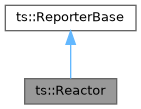
Public Member Functions | |
| Reactor (Report *report) | |
| Constructor. | |
| Reactor (ReporterBase *delegate) | |
| Constructor. | |
| virtual | ~Reactor () override |
| Destructor. | |
| int | addExitReference () |
| Coordinate future exitEventLoop(). | |
| bool | cancelAndWaitAsynchronousIO (EventId id, Device::IOSB &iosb, bool silent=false) |
| Cancel one specific pending asynchronous I/O. | |
| bool | cancelAsynchronousIO (EventId id, bool silent=false) |
| Cancel all pending asynchronous I/O on a system file descriptor or handle. | |
| bool | cancelProcessTermination (EventId id, bool silent=false) |
| Cancel a process termination event. | |
| bool | cancelTimer (EventId id, bool silent=false) |
| Cancel a timer. | |
| bool | close (bool silent=false) |
| Close the Reactor. | |
| bool | deleteAsynchronousIO (EventId id, bool silent=false) |
| Delete a notification of asynchronous I/O. | |
| bool | deleteEvent (EventId id, bool silent=false) |
| Delete a user event. | |
| bool | deleteReadNotify (EventId id, bool silent=false) |
| Delete a notification of read-ready or read-completion. | |
| bool | deleteReadNotify (SysSocketType sock, bool silent=false) |
| Delete a notification of read-ready or read-completion, by file descriptor or handle. | |
| bool | deleteWriteNotify (EventId id, bool silent=false) |
| Delete a notification of write-ready or write-completion. | |
| bool | deleteWriteNotify (SysSocketType sock, bool silent=false) |
| Delete a notification of write-ready or write-completion, by file descriptor or handle. | |
| void | exitEventLoop (bool success=true) |
| Exit processEventLoop() as soon as possible. | |
| int | freeExitReference (bool success=true) |
| Coordinated exitEventLoop(). | |
| SysSocketType | getSocket (EventId id) |
| Get the system-specific file descriptor or handle for an asynchronous or immediate I/O notification. | |
| bool | isActiveEvent (EventId id) |
| Check if an event (user-defined, timer, I/O) is still active in the reactor. | |
| bool | isOpen () const |
| Check if the Reactor is open. | |
| bool | muteReport (bool mute) |
| Temporarily mute the associated report. | |
| EventId | newAsynchronousIO (ReactorHandlerInterface *handler, SysSocketType sock) |
| Add in the reactor a notification of asynchronous I/O on a system file descriptor or handle. | |
| EventId | newEvent (ReactorHandlerInterface *handler) |
| Add a user event in the reactor. | |
| EventId | newProcessHandleTermination (ReactorHandlerInterface *handler, SysHandleType process_handle) |
| Add a process termination event in the reactor, using a process handle. | |
| EventId | newProcessIdTermination (ReactorHandlerInterface *handler, SysProcessIdType pid) |
| Add a process termination event in the reactor, using a process id. | |
| EventId | newReadNotify (ReactorHandlerInterface *handler, SysSocketType sock) |
| Add in the reactor a notification of read-ready on a system file descriptor. | |
| template<class Rep , class Period > | |
| EventId | newTimer (ReactorHandlerInterface *handler, cn::duration< Rep, Period > duration, bool repeat) |
| Add a timer in the reactor. | |
| EventId | newWriteNotify (ReactorHandlerInterface *handler, SysSocketType sock) |
| Add in the reactor a notification of write-ready or read-completion on a system file descriptor. | |
| bool | open () |
| Open and initialize the Reactor. | |
| bool | processEventLoop () |
| Process events until exit is requested. | |
| virtual Report & | report () const override |
| Access the Report which is associated with this object. | |
| Report * | setReport (Report *report) |
| Associate this object with another Report to log errors. | |
| ReporterBase * | setReport (ReporterBase *delegate) |
| Associate this object with another ReporterBase to log errors. | |
| bool | signalBroadcastEvent (int error_code=SYS_SUCCESS, const ObjectPtr &user_data=nullptr) |
| Signal a broadcast event in the reactor. | |
| bool | signalEvent (EventId id) |
| Signal a user event in the reactor. | |
| template<class... Args> | |
| void | trace (const UChar *fmt, Args &&... args) |
| Issue a low-level trace message if environment variable TS_REACTOR_TRACE is defined with a non-empty value. | |
Static Public Member Functions | |
| static int | SilentLevel (bool silent, int default_severity=Severity::Error) |
| Compute a log severity level from a "silent" parameter. | |
Event-driven reactor class implementing the "event loop" pattern.
A reactor is a single-threaded design pattern based on an "event loop". The application classes register handlers to be called when "events" occur in the future. The application-defined handlers typically start other background tasks (timers, I/O) and register other handlers to be called when these tasks complete.
Timers, process termination, and user-defined events (which can be triggered from other tasks) are directly handled by the class Reactor. Other types of features such as message queues, worker threads, and input/output are handled in "reactive classes" which execute on top of the Reactor.
There are two distinct reactive I/O models, with different implementations:
See the documentation of class Device for a detailed explanation of the differences.
The class Reactor encapsulates the various implementations and proposes a portable interface. However, while it is possible to unify the various types of immediate I/O (kqueue and epoll) in one single interface, it is impossible to unify immediate I/O and asynchronous I/O into the same interface. The way they shall be used, as well as the way the data buffers are managed, are too different. Therefore, the class Reactor exposes interfaces for both models. The application shall check the current I/O model using the "consteval" static methods UseImmediateIO() and UseAsynchronousIO() and then adopt the correct strategy.
In practice, the I/O multiplexing features of the class Reactor are not used by applications. They are used in a few specialized "reactive I/O" classes such as ReactiveUDPSocket or ReactiveTCPConnection. These classes are implemented on top of Reactor and have fully portable and homogeneous interfaces.
The Reactor shall be used from one single thread. Unless specified otherwise, all methods shall be invoked from the thread of the reactor, where the event loop is run. All handlers are invoked in the context of the thread which invoked processEventLoop(), except worker handlers which are invoked in the context of a worker thread. Therefore, worker handlers are not allowed to call methods of the reactor.
|
explicit |
Constructor.
| [in] | report | Where to report errors. The report object must remain valid as long as this object exists or setReport() is used with another Report object. If report is null, log messages are discarded. |
|
explicit |
Constructor.
| [in] | delegate | Use the report of another ReporterBase. If delegate is null, log messages are discarded. |
|
overridevirtual |
Destructor.
All resources, such as pending timers or user events, are deleted.
| bool ts::Reactor::open | ( | ) |
Open and initialize the Reactor.
Must be invoked before running the event loop or registering events.
| bool ts::Reactor::close | ( | bool | silent = false | ) |
Close the Reactor.
Must not be called from within the event loop. Automatically done in the destructor.
| [in] | silent | If true, do not report errors through the logger. |
|
inline |
| bool ts::Reactor::isActiveEvent | ( | EventId | id | ) |
Check if an event (user-defined, timer, I/O) is still active in the reactor.
| [in] | id | Envent id to check. |
| bool ts::Reactor::processEventLoop | ( | ) |
Process events until exit is requested.
| void ts::Reactor::exitEventLoop | ( | bool | success = true | ) |
Exit processEventLoop() as soon as possible.
This method is typically invoked from a handler. If it is invoked before processEventLoop(), then processEventLoop() exits immediately. The "exit request" condition is reset only when processEventLoop() returns.
| [in] | success | The value that processEventLoop() shall return. |
| int ts::Reactor::addExitReference | ( | ) |
Coordinate future exitEventLoop().
When several participants share the same reactor, we may want to exit the event loop when all participants are properly terminated. In that case, it is difficult for a participant to decide how to call exitEventLoop(). To coordinate a proper exitEventLoop() when all participants are terminated, each of them calls addExitReference() once on initialization, either inside the event loop or even before entering the event loop. When a participant considers itself as terminated, it calls freeExitReference(). When the number of references falls to zero, exitEventLoop() is automatically called.
| int ts::Reactor::freeExitReference | ( | bool | success = true | ) |
Coordinated exitEventLoop().
This function shall be called once for each addExitReference(). It decrements the reference counter of participants.
| [in] | success | The value that processEventLoop() shall return. Each participant sets its own value. If at least one participant sets success to false, processEventLoop() will return false. If all participants set success to true, processEventLoop() will return true. |
|
inline |
Add a timer in the reactor.
If the timer is one-shot (the default), the timer is automatically deleted after its expiration, after the handler is invoked. If the timer is repeated, it shall be explicitly canceled if needed.
| [in] | handler | Address of a handler to call when the timer expires. Return an error if set as nullptr. |
| [in] | duration | Duration of the timer. Must be strictly positive. |
| [in] | repeat | If true, the timer is repeated at regular intervals, every duration, until canceled. |
| bool ts::Reactor::cancelTimer | ( | EventId | id, |
| bool | silent = false |
||
| ) |
Cancel a timer.
| [in] | id | Timer to cancel. |
| [in] | silent | If true, do not report errors through the logger. |
| EventId ts::Reactor::newEvent | ( | ReactorHandlerInterface * | handler | ) |
Add a user event in the reactor.
| [in] | handler | Address of a handler to call when the event is signalled. Return an error if set as nullptr. |
| bool ts::Reactor::signalEvent | ( | EventId | id | ) |
Signal a user event in the reactor.
As an exception to the single-thread-reactor rule, this method can be invoked from any thread.
| [in] | id | Event to signal. |
| bool ts::Reactor::deleteEvent | ( | EventId | id, |
| bool | silent = false |
||
| ) |
Delete a user event.
| [in] | id | Event to delete. |
| [in] | silent | If true, do not report errors through the logger. |
| bool ts::Reactor::signalBroadcastEvent | ( | int | error_code = SYS_SUCCESS, |
| const ObjectPtr & | user_data = nullptr |
||
| ) |
Signal a broadcast event in the reactor.
A broadcast event is sent to all currently registered handlers in the reactor. If the same handler is registered for several events (e.g. two timers, one user event and one I/O), the handler is called only once per broadcast event.
A broadcast event is typically used to wake all objects which are waiting for something and signal to them that the application is terminating, for instance, and they should cleanup and close.
| [in] | error_code | Application-specific error code, passed to the handler. |
| [in] | user_data | Application-specific user-data shared pointer, passed to the handler. |
| EventId ts::Reactor::newProcessIdTermination | ( | ReactorHandlerInterface * | handler, |
| SysProcessIdType | pid | ||
| ) |
Add a process termination event in the reactor, using a process id.
| [in] | handler | Address of a handler to call when the process terminates. Return an error if set as nullptr. The handler is invoked when the process is no longer there. It is possible that the process was already terminated for a while. It is even possible that the process never really started. In all cases, the handler is invoked when the watched process doesn't exist, whether it is terminated or has never existed. |
| [in] | pid | Process id to watch. If that process id is unknown, it is assumed that the process is already terminated and the handler will be called as soon as possible. |
| EventId ts::Reactor::newProcessHandleTermination | ( | ReactorHandlerInterface * | handler, |
| SysHandleType | process_handle | ||
| ) |
Add a process termination event in the reactor, using a process handle.
Note: Only Windows identifies a process by handle, in addition to process id. On other operating systems, this method always reports an error.
| [in] | handler | Address of a handler to call when the process terminates. Return an error if set as nullptr. The handler is invoked when the process is no longer there. It is possible that the process was already terminated for a while. It is even possible that the process never really started. In all cases, the handler is invoked when the watched process doesn't exist, whether it is terminated or has never existed. |
| [in] | process_handle | Process handle to watch. |
| bool ts::Reactor::cancelProcessTermination | ( | EventId | id, |
| bool | silent = false |
||
| ) |
Cancel a process termination event.
| [in] | id | Event to delete. |
| [in] | silent | If true, do not report errors through the logger. |
| SysSocketType ts::Reactor::getSocket | ( | EventId | id | ) |
Get the system-specific file descriptor or handle for an asynchronous or immediate I/O notification.
| [in] | id | Event id, as previously returned by newAsynchronousIO(), newReadNotify(), or newWriteNotify(). |
| EventId ts::Reactor::newAsynchronousIO | ( | ReactorHandlerInterface * | handler, |
| SysSocketType | sock | ||
| ) |
Add in the reactor a notification of asynchronous I/O on a system file descriptor or handle.
This method is normally never used in applications. It is used only by "reactive I/O classes", in the asynchronous I/O model.
| [in] | handler | Address of a handler to call when any asynchronous I/O completes on the specified system handle. Return an error if set as nullptr. |
| [in] | sock | A system-specific file descriptor or handle. This can be a socket or something else. |
| bool ts::Reactor::cancelAsynchronousIO | ( | EventId | id, |
| bool | silent = false |
||
| ) |
Cancel all pending asynchronous I/O on a system file descriptor or handle.
This method is normally never used in applications. It is used only by "reactive I/O classes", in the asynchronous I/O model.
| [in] | id | Asynchronous I/O id, as previously returned by newAsynchronousIO(). |
| [in] | silent | If true, do not report errors through the logger. |
IMPORTANT: After canceling all asynchronous I/O, the application shall wait for the reception of all I/O completions (presumably with an error status) before releasing the data buffers.
| bool ts::Reactor::cancelAndWaitAsynchronousIO | ( | EventId | id, |
| Device::IOSB & | iosb, | ||
| bool | silent = false |
||
| ) |
Cancel one specific pending asynchronous I/O.
This method is normally never used in applications. It is used only by "reactive I/O classes", in the asynchronous I/O model. Warning: This is a blocking call. It shall be used in case of trouble only.
| [in] | id | Asynchronous I/O id, as previously returned by newAsynchronousIO(). |
| [in,out] | iosb | The asynchronous I/O status block. |
| [in] | silent | If true, do not report errors through the logger. |
| bool ts::Reactor::deleteAsynchronousIO | ( | EventId | id, |
| bool | silent = false |
||
| ) |
Delete a notification of asynchronous I/O.
This method is normally never used in applications. It is used only by "reactive I/O classes", in the asynchronous I/O model.
| [in] | id | Asynchronous I/O id, as previously returned by newAsynchronousIO(). |
| [in] | silent | If true, do not report errors through the logger. |
| EventId ts::Reactor::newReadNotify | ( | ReactorHandlerInterface * | handler, |
| SysSocketType | sock | ||
| ) |
Add in the reactor a notification of read-ready on a system file descriptor.
This method is normally never used in applications. It is used only by "reactive I/O classes", in the immediate I/O model.
| [in] | handler | Address of a handler to call when the operation is ready. Return an error if set as nullptr. |
| [in] | sock | A system-specific file descriptor or handle. This can be a socket or something else. |
| bool ts::Reactor::deleteReadNotify | ( | EventId | id, |
| bool | silent = false |
||
| ) |
Delete a notification of read-ready or read-completion.
This method is normally never used in applications. It is used only by "reactive I/O classes", in the immediate I/O model.
| [in] | id | Event to delete. |
| [in] | silent | If true, do not report errors through the logger. |
| bool ts::Reactor::deleteReadNotify | ( | SysSocketType | sock, |
| bool | silent = false |
||
| ) |
Delete a notification of read-ready or read-completion, by file descriptor or handle.
This method is normally never used in applications. It is used only by "reactive I/O classes", in the immediate I/O model.
| [in] | sock | A system-specific file descriptor or handle. This can be a socket or something else. |
| [in] | silent | If true, do not report errors through the logger. |
| EventId ts::Reactor::newWriteNotify | ( | ReactorHandlerInterface * | handler, |
| SysSocketType | sock | ||
| ) |
Add in the reactor a notification of write-ready or read-completion on a system file descriptor.
This method is normally never used in applications. It is used only by "reactive I/O classes", in the immediate I/O model.
| [in] | handler | Address of a handler to call when the operation is ready. Return an error if set as nullptr. |
| [in] | sock | A system-specific file descriptor or handle. This can be a socket or something else. |
| bool ts::Reactor::deleteWriteNotify | ( | EventId | id, |
| bool | silent = false |
||
| ) |
Delete a notification of write-ready or write-completion.
This method is normally never used in applications. It is used only by "reactive I/O classes", in the immediate I/O model.
| [in] | id | Event to delete. |
| [in] | silent | If true, do not report errors through the logger. |
| bool ts::Reactor::deleteWriteNotify | ( | SysSocketType | sock, |
| bool | silent = false |
||
| ) |
Delete a notification of write-ready or write-completion, by file descriptor or handle.
This method is normally never used in applications. It is used only by "reactive I/O classes", in the immediate I/O model.
| [in] | sock | A system-specific file descriptor or handle. This can be a socket or something else. |
| [in] | silent | If true, do not report errors through the logger. |
Issue a low-level trace message if environment variable TS_REACTOR_TRACE is defined with a non-empty value.
This is typically use to troubleshoot the internals of a Reactor on a given platform.
| [in] | fmt | Format string with embedded '%' sequences. |
| [in] | args | List of arguments to substitute in the format string. |
|
overridevirtualinherited |
Access the Report which is associated with this object.
Can be called from another thread only if the Report object is thread-safe.
Implements ts::ReporterInterface.
Associate this object with another Report to log errors.
| [in] | report | Where to report errors. The report object must remain valid as long as this object exists or setReport() is used with another Report object. If report is null, log messages are discarded. |
|
inherited |
Associate this object with another ReporterBase to log errors.
| [in] | delegate | Use the report of another ReporterBase. If delegate is null, the previous explicit Report is used.. |
|
inherited |
Temporarily mute the associated report.
| [in] | mute | It true, report() will return a null report (log messages are discarded), until muteReport() is invoked again with mute set to false. |
|
inlinestaticinherited |
Compute a log severity level from a "silent" parameter.
Some subclass methods have a "silent" parameter to avoid reporting errors which may be insignificant, typically when closing a device after an error, in which case the close operation may produce other errors if the previous error left the device in an inconsistent state. While those errors should not be displayed as errors, we still display them at debug level.
| [in] | silent | If true, do not report errors, report debug messages instead. |
| [in] | default_severity | Default severity, in non-silent mode (error by default). |
 1.9.8
1.9.8