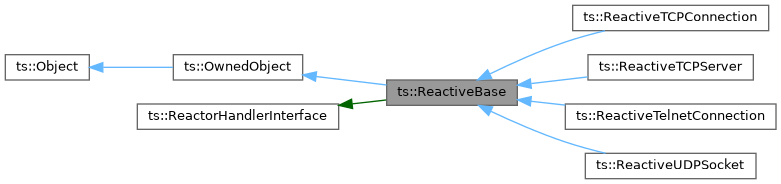
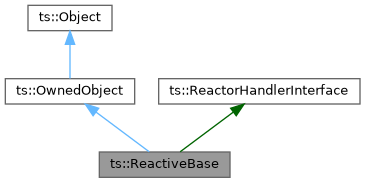
Virtual base class for reactive classes in a Reactor environment.
More...
#include <tsReactiveBase.h>
|
| static int | SilentLevel (bool silent, int default_severity=Severity::Error) |
| | Compute a log severity level from a "silent" parameter.
|
| |
|
| bool | createSignalQueuedOperations () |
| | Create, if necessary, the dedicated user event for signalQueuedOperations().
|
| |
| void | deactivateQueuedOperations (bool silent) |
| | Deactivate the execution of processQueuedOperations() in the context of a Reactor handler.
|
| |
| virtual void | handleAsynchronousIO (Reactor &reactor, EventId id, Device::IOSB &iosb, size_t io_size) |
| | Handle an asynchronous I/O completion event in a Reactor.
|
| |
| virtual void | handleBroadcastEvent (Reactor &reactor, int error_code, const ObjectPtr &user_data) |
| | Handle a broadcast event in a Reactor.
|
| |
| virtual void | handleProcessTermination (Reactor &reactor, EventId id, int pid) |
| | Handle a process termination event in a Reactor.
|
| |
| virtual void | handleReadReady (Reactor &reactor, EventId id, int error_code) |
| | Handle a read-ready event in a Reactor.
|
| |
| virtual void | handleTimer (Reactor &reactor, EventId id) |
| | Handle a timer in a Reactor.
|
| |
| virtual void | handleUserEvent (Reactor &, EventId) override |
| | Handle a user-defined event in a Reactor.
|
| |
| virtual void | handleWriteReady (Reactor &reactor, EventId id, int error_code) |
| | Handle a write-ready event in a Reactor.
|
| |
| virtual void | processQueuedOperations () |
| | This virtual method processes operations in the context of a Reactor handler.
|
| |
| bool | uncheckedSignalQueuedOperations () |
| | Trigger the execution of processQueuedOperations() from another thread.
|
| |
Virtual base class for reactive classes in a Reactor environment.
◆ ReactiveBase()
| ts::ReactiveBase::ReactiveBase |
( |
Reactor & |
reactor | ) |
|
|
explicit |
Constructor.
- Parameters
-
| [in,out] | reactor | Associated reactor. The reactor object must remain valid as long as this object is valid. |
◆ reactor()
| Reactor & ts::ReactiveBase::reactor |
( |
| ) |
|
|
inline |
Get a reference to the associated reactor.
- Returns
- A reference to the associated reactor.
◆ signalQueuedOperations()
| bool ts::ReactiveBase::signalQueuedOperations |
( |
| ) |
|
Trigger the execution of processQueuedOperations() in the context of a Reactor handler.
Create if necessary and then signal a dedicated user event.
- Returns
- True on success, false on error.
◆ deactivateQueuedOperations()
| void ts::ReactiveBase::deactivateQueuedOperations |
( |
bool |
silent | ) |
|
|
protected |
Deactivate the execution of processQueuedOperations() in the context of a Reactor handler.
Deactivate and delete the dedicated user event.
- Parameters
-
| [in] | silent | If true, do not report errors through the logger. |
◆ createSignalQueuedOperations()
| bool ts::ReactiveBase::createSignalQueuedOperations |
( |
| ) |
|
|
protected |
◆ uncheckedSignalQueuedOperations()
| bool ts::ReactiveBase::uncheckedSignalQueuedOperations |
( |
| ) |
|
|
protected |
◆ processQueuedOperations()
| virtual void ts::ReactiveBase::processQueuedOperations |
( |
| ) |
|
|
protectedvirtual |
◆ handleUserEvent()
| virtual void ts::ReactiveBase::handleUserEvent |
( |
Reactor & |
reactor, |
|
|
EventId |
id |
|
) |
| |
|
overrideprotectedvirtual |
◆ report()
| virtual Report & ts::ReporterBase::report |
( |
| ) |
const |
|
overridevirtualinherited |
Access the Report which is associated with this object.
Can be called from another thread only if the Report object is thread-safe.
- Returns
- A reference to the associated report.
Implements ts::ReporterInterface.
◆ setReport() [1/2]
Associate this object with another Report to log errors.
- Parameters
-
| [in] | report | Where to report errors. The report object must remain valid as long as this object exists or setReport() is used with another Report object. If report is null, log messages are discarded. |
- Returns
- The address of the previous Report object or a null pointer if there was none.
◆ setReport() [2/2]
Associate this object with another ReporterBase to log errors.
- Parameters
-
| [in] | delegate | Use the report of another ReporterBase. If delegate is null, the previous explicit Report is used.. |
- Returns
- The address of the previous ReporterBase object or a null pointer if there was none.
◆ muteReport()
| bool ts::ReporterBase::muteReport |
( |
bool |
mute | ) |
|
|
inherited |
Temporarily mute the associated report.
- Parameters
-
| [in] | mute | It true, report() will return a null report (log messages are discarded), until muteReport() is invoked again with mute set to false. |
- Returns
- Previous state of the mute field.
◆ SilentLevel()
| static int ts::ReporterBase::SilentLevel |
( |
bool |
silent, |
|
|
int |
default_severity = Severity::Error |
|
) |
| |
|
inlinestaticinherited |
Compute a log severity level from a "silent" parameter.
Some subclass methods have a "silent" parameter to avoid reporting errors which may be insignificant, typically when closing a device after an error, in which case the close operation may produce other errors if the previous error left the device in an inconsistent state. While those errors should not be displayed as errors, we still display them at debug level.
- Parameters
-
| [in] | silent | If true, do not report errors, report debug messages instead. |
| [in] | default_severity | Default severity, in non-silent mode (error by default). |
- Returns
- Error when silent is false, Debug otherwise.
◆ handleTimer()
| virtual void ts::ReactorHandlerInterface::handleTimer |
( |
Reactor & |
reactor, |
|
|
EventId |
id |
|
) |
| |
|
virtualinherited |
Handle a timer in a Reactor.
- Parameters
-
| [in,out] | reactor | Reactor into which the handler is invoked. |
| [in] | id | Id of the timer which expires. |
◆ handleBroadcastEvent()
| virtual void ts::ReactorHandlerInterface::handleBroadcastEvent |
( |
Reactor & |
reactor, |
|
|
int |
error_code, |
|
|
const ObjectPtr & |
user_data |
|
) |
| |
|
virtualinherited |
Handle a broadcast event in a Reactor.
A broadcast event is sent to all currently registered events in the reactor.
- Parameters
-
◆ handleProcessTermination()
| virtual void ts::ReactorHandlerInterface::handleProcessTermination |
( |
Reactor & |
reactor, |
|
|
EventId |
id, |
|
|
int |
pid |
|
) |
| |
|
virtualinherited |
Handle a process termination event in a Reactor.
This handler is invoked when the process is no longer there. It is possible that the process was already terminated for a while. It is even possible that the process never really started. There is no portable way to get the process termination status.
- Parameters
-
| [in,out] | reactor | Reactor into which the handler is invoked. |
| [in] | id | Id of the event which was signaled. |
| [in] | pid | Process id of the terminated process. |
◆ handleReadReady()
| virtual void ts::ReactorHandlerInterface::handleReadReady |
( |
Reactor & |
reactor, |
|
|
EventId |
id, |
|
|
int |
error_code |
|
) |
| |
|
virtualinherited |
Handle a read-ready event in a Reactor.
This handler is only invoked in the immediate I/O model.
- Parameters
-
| [in,out] | reactor | Reactor into which the handler is invoked. |
| [in] | id | Id of the event which was signaled. |
| [in] | error_code | System-specific error code, zero on success, SYS_ERROR in case of unknown error. |
Reimplemented in ts::ReactiveStream.
◆ handleWriteReady()
| virtual void ts::ReactorHandlerInterface::handleWriteReady |
( |
Reactor & |
reactor, |
|
|
EventId |
id, |
|
|
int |
error_code |
|
) |
| |
|
virtualinherited |
Handle a write-ready event in a Reactor.
This handler is only invoked in the immediate I/O model.
- Parameters
-
| [in,out] | reactor | Reactor into which the handler is invoked. |
| [in] | id | Id of the event which was signaled. |
| [in] | error_code | System-specific error code, zero on success, SYS_ERROR in case of unknown error. |
Reimplemented in ts::ReactiveStream, and ts::ReactiveTCPConnection.
◆ handleAsynchronousIO()
| virtual void ts::ReactorHandlerInterface::handleAsynchronousIO |
( |
Reactor & |
reactor, |
|
|
EventId |
id, |
|
|
Device::IOSB & |
iosb, |
|
|
size_t |
io_size |
|
) |
| |
|
virtualinherited |
Handle an asynchronous I/O completion event in a Reactor.
This handler is only invoked in the asynchronous I/O model.
- Parameters
-
| [in,out] | reactor | Reactor into which the handler is invoked. |
| [in] | id | Id of the event which was signaled. |
| [in,out] | iosb | IOSB structure which was used when the asynchronous I/O was started. A system-specific error code is in iosb, SYS_CANCELED if the I/O was canceled before completion. |
| [in] | io_size | Size of the I/O in bytes. |
Reimplemented in ts::ReactiveStream, and ts::ReactiveTCPConnection.
The documentation for this class was generated from the following file:

 1.9.8
1.9.8