TSDuck v3.45-4787
MPEG Transport Stream Toolkit
Loading...
Searching...
No Matches
ts::WebRequest Class Reference

Perform a simple Web request (HTTP, HTTPS, FTP). More...

#include <tsWebRequest.h>
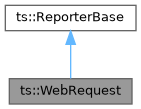
Inheritance diagram for ts::WebRequest:
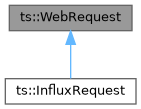
Collaboration diagram for ts::WebRequest:

Public Member Functions

 WebRequest (Report *report, bool non_blocking=false)
 Constructor.
 
 WebRequest (ReporterBase *delegate, bool non_blocking=false)
 Constructor.
 
virtual ~WebRequest () override
 Destructor.
 
void abort ()
 Abort a transfer in progress.
 
size_t announcedContentSize () const
 Get the announced content size in bytes.
 
void clearPostData ()
 Clear previous POST data.
 
void clearRequestHeaders ()
 Clear all headers which will be sent with the request.
 
bool close ()
 Close the transfer.
 
size_t contentSize () const
 Get the size in bytes of the downloaded content.
 
bool deleteCookiesFile () const
 Delete the cookies file, if one was defined.
 
void deleteRequestHeader (const UString &name)
 Delete all headers with a given name.
 
void disableCookies ()
 Disable the use of cookies for all requests.
 
bool downloadBinaryContent (const UString &url, ByteBlock &data, size_t chunk_size=DEFAULT_CHUNK_SIZE)
 Download the content of the URL as binary data in one operation.
 
bool downloadFile (const UString &url, const fs::path &file_name, size_t chunk_size=DEFAULT_CHUNK_SIZE)
 Download the content of the URL in a file in one operation.
 
bool downloadTextContent (const UString &url, UString &text, size_t chunk_size=DEFAULT_CHUNK_SIZE)
 Download the content of the URL as text in one operation.
 
void enableCompression (bool on=true)
 Enable compression.
 
void enableCookies (const fs::path &file_name=fs::path())
 Enable the use of cookies for all requests using this instance.
 
UString finalURL () const
 Get the final URL of the actual download operation.
 
fs::path getCookiesFileName () const
 Get the file name to use for cookies for all requests using this instance.
 
SysHandleType getHandle () const
 Get the underlying file descriptor or device handle.
 
virtual SysHandleType getReadHandle () const
 Get the underlying file descriptor or device handle for read operations.
 
SysSocketType getReadSocket () const
 Get the underlying file descriptor or device handle as a system socket handle for read operations.
 
void getResponseHeaders (UStringToUStringMultiMap &headers) const
 Get all response headers.
 
SysSocketType getSocket () const
 Get the underlying file descriptor or device handle as a system socket handle.
 
virtual SysHandleType getWriteHandle () const
 Get the underlying file descriptor or device handle for write operations.
 
SysSocketType getWriteSocket () const
 Get the underlying file descriptor or device handle as a system socket handle for write operations.
 
bool httpClientError () const
 Check if the HTTP status code indicates a client error.
 
bool httpServerError () const
 Check if the HTTP status code indicates a server error.
 
int httpStatus () const
 Get the HTTP status code (200, 404, etc).
 
bool httpSuccess () const
 Check if the HTTP status code indicates success.
 
bool isNonBlocking () const
 Check if the device is in non-blocking mode.
 
bool isOpen () const
 Check if a transfer is open.
 
bool isSupportedByReactor (bool recheck=false)
 Check if the device is supported by a reactor for non-blocking or asynchronous I/O.
 
UString mimeType (bool simple=true, bool lowercase=true) const
 Get the MIME type in the response headers.
 
bool muteReport (bool mute)
 Temporarily mute the associated report.
 
bool open (const UString &url, IOSB *iosb=nullptr)
 Open an URL and start the transfer.
 
UString originalURL () const
 Get the original URL, as set by setURL().
 
const UStringproxyHost () const
 Get the current actual proxy host.
 
const UStringproxyPassword () const
 Get the current actual proxy user password.
 
uint16_t proxyPort () const
 Get the current actual proxy port number.
 
const UStringproxyUser () const
 Get the current actual proxy user name.
 
bool receive (void *buffer, size_t max_size, size_t &ret_size, IOSB *iosb=nullptr)
 Receive data.
 
UString reponseHeader (const UString &name) const
 Get the value of one header.
 
virtual Reportreport () const override
 Access the Report which is associated with this object.
 
const UStringToUStringMultiMapresponseHeaders () const
 Get all response headers.
 
void setArgs (const WebRequestArgs &args)
 Set various arguments from command line.
 
void setAutoRedirect (bool on)
 Enable or disable the automatic redirection of HTTP requests.
 
void setConnectionTimeout (cn::milliseconds timeout)
 Set the connection timeout for this request.
 
void setInsecure (bool on=true)
 Enable or disable HTTPS security (certificate validation).
 
bool setNonBlocking (bool non_blocking)
 Set the device in non-blocking mode.
 
void setPostData (const ByteBlock &data)
 Set data to POST.
 
void setPostData (const UString &data, const UString content_type=u"text/plain; charset=utf-8")
 Set data to POST.
 
void setProxyHost (const UString &host, uint16_t port)
 Set the optional proxy host and port for this request.
 
void setProxyUser (const UString &user, const UString &password)
 Set the optional proxy authentication for this request.
 
void setReceiveTimeout (cn::milliseconds timeout)
 Set the timeout for each receive operation.
 
ReportsetReport (Report *report)
 Associate this object with another Report to log errors.
 
ReporterBasesetReport (ReporterBase *delegate)
 Associate this object with another ReporterBase to log errors.
 
void setRequestHeader (const UString &name, const UString &value)
 Set a header which will be sent with the request.
 
void setUserAgent (const UString &name=UString())
 Set the user agent name to use in HTTP headers.
 
const UStringuserAgent () const
 Get the current user agent name to use in HTTP headers.
 

Static Public Member Functions

static UString GetLibraryVersion ()
 Get the version of the underlying HTTP library.
 
static bool IsPendingStatus (int error_code)
 This static method checks if a system error code means "I/O in progress" (asynchronous I/O) or "I/O would block" (non-blocking I/O).
 
static void SetDefaultProxyHost (const UString &host, uint16_t port)
 Set the default proxy host and port for all subsequent requests.
 
static void SetDefaultProxyUser (const UString &user, const UString &password)
 Set the default proxy authentication for all subsequent requests.
 
static int SilentLevel (bool silent, int default_severity=Severity::Error)
 Compute a log severity level from a "silent" parameter.
 

Static Public Attributes

static constexpr size_t DEFAULT_CHUNK_SIZE = 64 * 1024
 Default download chunk size for bulk transfers.
 
static constexpr uint16_t DEFAULT_HTTP_PORT = 80
 Default TCP port for HTTP.
 
static constexpr uint16_t DEFAULT_HTTPS_PORT = 443
 Default TCP port for HTTPS.
 
static constexpr const UCharDEFAULT_USER_AGENT = u"tsduck"
 Default user agent string ("tsduck").
 

Protected Member Functions

virtual bool allowSetNonBlocking () const
 Check that the non-blocking mode can be set.
 
bool checkNonBlocking (bool non_blocking, const UChar *opname)
 Check the blocking mode of a device.
 
bool checkNonBlocking (IOSB *iosb, const UChar *opname)
 Check the blocking mode of a device.
 
int genericSystemRead (void *addr, size_t max_size, size_t &ret_size, const AbortInterface *abort, Device::IOSB *iosb, uint64_t position)
 Generic system read operation.
 
int genericSystemWrite (const void *addr, size_t size, size_t &written_size, Device::IOSB *iosb, uint64_t position)
 Generic system write operation.
 
bool setSystemNonBlocking (bool non_blocking)
 Low-level method to set the system file or socket descriptor in non-blocking mode.
 

Detailed Description

Perform a simple Web request (HTTP, HTTPS, FTP).

On UNIX systems, the implementation uses libcurl. On Windows systems, the implementation uses Microsoft Wininet. We could have used libcurl on Windows but building it was a pain...

The proxy and transfer settings must be set before starting any download operation. The HTTP status and the response headers are available after a successful download start.

By default, no proxy is used. If no proxy is set, the default proxy is used (system configuration on Windows, http_proxy environment on Unix systems).

Constructor & Destructor Documentation

◆ WebRequest() [1/2]

ts::WebRequest::WebRequest ( Report report,
bool  non_blocking = false 
)
explicit

Constructor.

Parameters
[in]reportWhere to report errors. The report object must remain valid as long as this object exists or setReport() is used with another Report object. If report is null, log messages are discarded.
[in]non_blockingIt true, the Web request is initially set in non-blocking mode.

◆ WebRequest() [2/2]

ts::WebRequest::WebRequest ( ReporterBase delegate,
bool  non_blocking = false 
)
explicit

Constructor.

Parameters
[in]delegateUse the report of another ReporterBase. If delegate is null, log messages are discarded.
[in]non_blockingIt true, the Web request is initially set in non-blocking mode.

Member Function Documentation

◆ setConnectionTimeout()

void ts::WebRequest::setConnectionTimeout ( cn::milliseconds  timeout)
inline

Set the connection timeout for this request.

Parameters
[in]timeoutConnection timeout in milliseconds.

◆ setReceiveTimeout()

void ts::WebRequest::setReceiveTimeout ( cn::milliseconds  timeout)
inline

Set the timeout for each receive operation.

Parameters
[in]timeoutReception timeout in milliseconds.

◆ setProxyHost()

void ts::WebRequest::setProxyHost ( const UString host,
uint16_t  port 
)

Set the optional proxy host and port for this request.

Parameters
[in]hostProxy host name or address.
[in]portProxy port number.

◆ setProxyUser()

void ts::WebRequest::setProxyUser ( const UString user,
const UString password 
)

Set the optional proxy authentication for this request.

Parameters
[in]userProxy user name.
[in]passwordProxy user's password.

◆ SetDefaultProxyHost()

static void ts::WebRequest::SetDefaultProxyHost ( const UString host,
uint16_t  port 
)
static

Set the default proxy host and port for all subsequent requests.

Parameters
[in]hostProxy host name or address.
[in]portProxy port number.

◆ SetDefaultProxyUser()

static void ts::WebRequest::SetDefaultProxyUser ( const UString user,
const UString password 
)
static

Set the default proxy authentication for all subsequent requests.

Parameters
[in]userProxy user name.
[in]passwordProxy user's password.

◆ proxyHost()

const UString & ts::WebRequest::proxyHost ( ) const

Get the current actual proxy host.

Returns
A constant reference to the proxy host name.

◆ proxyPort()

uint16_t ts::WebRequest::proxyPort ( ) const

Get the current actual proxy port number.

Returns
The proxy port number.

◆ proxyUser()

const UString & ts::WebRequest::proxyUser ( ) const

Get the current actual proxy user name.

Returns
A constant reference to the proxy user name.

◆ proxyPassword()

const UString & ts::WebRequest::proxyPassword ( ) const

Get the current actual proxy user password.

Returns
A constant reference to the proxy user password.

◆ enableCookies()

void ts::WebRequest::enableCookies ( const fs::path &  file_name = fs::path())

Enable the use of cookies for all requests using this instance.

Parameters
[in]file_nameThe name of the file to use to load and store cookies. On Windows, there is an implicit per-user cookie repository and fileName is ignored. On Unix systems, this file is used to store and retrieve cookies in the libcurl format. When fileName is empty, use a temporary file name.

◆ disableCookies()

void ts::WebRequest::disableCookies ( )

Disable the use of cookies for all requests.

Cookies are initially disabled by default.

◆ getCookiesFileName()

fs::path ts::WebRequest::getCookiesFileName ( ) const

Get the file name to use for cookies for all requests using this instance.

  • On Linux, return the current cookie file name, possibly the name of a temporary file if EnableCookies() was called with an empty string.
  • On Windows, the cookie repository is defined per user. There is no specific per-application file and this method always report an empty string.
    Returns
    The cookie file name.

◆ deleteCookiesFile()

bool ts::WebRequest::deleteCookiesFile ( ) const

Delete the cookies file, if one was defined.

Returns
True on success, false on error.

◆ setUserAgent()

void ts::WebRequest::setUserAgent ( const UString name = UString())
inline

Set the user agent name to use in HTTP headers.

Parameters
[in]nameThe user agent name. If empty, DEFAULT_USER_AGENT is used.

◆ userAgent()

const UString & ts::WebRequest::userAgent ( ) const
inline

Get the current user agent name to use in HTTP headers.

Returns
A constant reference to the user agent name to use in HTTP headers.

◆ enableCompression()

void ts::WebRequest::enableCompression ( bool  on = true)
inline

Enable compression.

Compression is disabled by default.

Parameters
[in]onBoolean setting compression on or off.

◆ setInsecure()

void ts::WebRequest::setInsecure ( bool  on = true)
inline

Enable or disable HTTPS security (certificate validation).

Certificate validation is enabled by default.

Parameters
[in]onIf true, disable certificate validation.

◆ setAutoRedirect()

void ts::WebRequest::setAutoRedirect ( bool  on)
inline

Enable or disable the automatic redirection of HTTP requests.

This option is active by default.

Parameters
[in]onIf true, allow automatic redirection of HTTP requests.

◆ setArgs()

void ts::WebRequest::setArgs ( const WebRequestArgs args)

Set various arguments from command line.

Parameters
[in]argsCommand line arguments.

◆ setRequestHeader()

void ts::WebRequest::setRequestHeader ( const UString name,
const UString value 
)

Set a header which will be sent with the request.

If the same header already exists with another value, a new header is added.

Parameters
[in]nameThe header name.
[in]valueThe header value.

◆ deleteRequestHeader()

void ts::WebRequest::deleteRequestHeader ( const UString name)

Delete all headers with a given name.

Parameters
[in]nameThe header name.

◆ setPostData() [1/2]

void ts::WebRequest::setPostData ( const UString data,
const UString  content_type = u"text/plain; charset=utf-8" 
)

Set data to POST.

The request will be a POST one.

Parameters
[in]dataText POST data. The text will be sent in UTF-8 format.
[in]content_typeThe content type to set in the request headers. The default "Content-Type" header is "text/plain; charset=utf-8", which is usually appropriate. When set to the empty string, no header is set.

◆ setPostData() [2/2]

void ts::WebRequest::setPostData ( const ByteBlock data)

Set data to POST.

The request will be a POST one.

Parameters
[in]dataBinary POST data.

◆ clearPostData()

void ts::WebRequest::clearPostData ( )

Clear previous POST data.

The request will be a GET one.

◆ open()

bool ts::WebRequest::open ( const UString url,
IOSB iosb = nullptr 
)

Open an URL and start the transfer.

For HTTP request, perform all redirections and get response headers.

Parameters
[in]urlThe complete URL to fetch.
[in,out]iosbAddress of an IOSB structure. If non-null, the request must be in non-blocking mode. When null, the request must be in blocking mode (the default). See the description of IOSB. Important: The parameter iosb should not be used by applications. It should be used only by "reactive classes", which work in combination with a Reactor.
Returns
True on success, false on error.

◆ isOpen()

bool ts::WebRequest::isOpen ( ) const
inline

Check if a transfer is open.

Returns
True if a transfer is open, false otherwise.

◆ httpStatus()

int ts::WebRequest::httpStatus ( ) const
inline

Get the HTTP status code (200, 404, etc).

Returns
The HTTP status code.

◆ httpSuccess()

bool ts::WebRequest::httpSuccess ( ) const
inline

Check if the HTTP status code indicates success.

The HTTP status codes are classified as follow (Wikipedia):

  • 1xx informational response – the request was received, continuing process
  • 2xx successful – the request was successfully received, understood, and accepted
  • 3xx redirection – further action needs to be taken in order to complete the request
  • 4xx client error – the request contains bad syntax or cannot be fulfilled
  • 5xx server error – the server failed to fulfil an apparently valid request
    Returns
    True if the HTTP status code indicates success.

◆ httpClientError()

bool ts::WebRequest::httpClientError ( ) const
inline

Check if the HTTP status code indicates a client error.

Returns
True if the HTTP status code indicates a client error.

◆ httpServerError()

bool ts::WebRequest::httpServerError ( ) const
inline

Check if the HTTP status code indicates a server error.

Returns
True if the HTTP status code indicates a server error.

◆ announcedContentSize()

size_t ts::WebRequest::announcedContentSize ( ) const
inline

Get the announced content size in bytes.

This is the value which was sent in the content headers. This may be zero, this may not be the actual size of the content to download.

Returns
Announced content size in bytes.

◆ getResponseHeaders()

void ts::WebRequest::getResponseHeaders ( UStringToUStringMultiMap headers) const
inline

Get all response headers.

Parameters
[out]headersA multimap of all response headers.

◆ responseHeaders()

const UStringToUStringMultiMap & ts::WebRequest::responseHeaders ( ) const
inline

Get all response headers.

Returns
A constant reference to a map of response headers.

◆ reponseHeader()

UString ts::WebRequest::reponseHeader ( const UString name) const

Get the value of one header.

Parameters
[in]nameHeader name, case sensitive.
Returns
Header value or an empty string when the header is not found. If the header is present more than once, the first value is returned.

◆ mimeType()

UString ts::WebRequest::mimeType ( bool  simple = true,
bool  lowercase = true 
) const

Get the MIME type in the response headers.

Parameters
[in]simpleIf true, simple type name. If false, return the full specification with options.
[in]lowercaseForce lowercase in the result.
Returns
The MIME type.

◆ originalURL()

UString ts::WebRequest::originalURL ( ) const
inline

Get the original URL, as set by setURL().

Returns
The original URL.

◆ finalURL()

UString ts::WebRequest::finalURL ( ) const
inline

Get the final URL of the actual download operation.

It can be different from originalURL() if some HTTP redirections were performed. When called before a download operation, return originalURL().

If redirections are disabled using setAutoRedirect() and the site returned a redirection, finalURL() returns the redirected URL.

Returns
The final / redirected URL.

◆ receive()

bool ts::WebRequest::receive ( void *  buffer,
size_t  max_size,
size_t &  ret_size,
IOSB iosb = nullptr 
)

Receive data.

Parameters
[out]bufferAddress of the buffer for the received data.
[in]max_sizeSize in bytes of the reception buffer.
[out]ret_sizeSize in bytes of the received data. Will never be larger than max_size. When ret_size is zero, this is the end of the transfer.
[in,out]iosbAddress of an IOSB structure. If non-null, the request must be in non-blocking mode. When null, the request must be in blocking mode (the default). See the description of IOSB. Important: The parameter iosb should not be used by applications. It should be used only by "reactive classes", which work in combination with a Reactor.
Returns
True on success, false on error. A successful end of transfer is reported when ret_size is zero and the returned value is true.

◆ close()

bool ts::WebRequest::close ( )

Close the transfer.

Returns
True on success, false on error.

◆ abort()

void ts::WebRequest::abort ( )

Abort a transfer in progress.

Can be called from another thread.

◆ contentSize()

size_t ts::WebRequest::contentSize ( ) const
inline

Get the size in bytes of the downloaded content.

Returns
Size in bytes of the downloaded content.

◆ downloadBinaryContent()

bool ts::WebRequest::downloadBinaryContent ( const UString url,
ByteBlock data,
size_t  chunk_size = DEFAULT_CHUNK_SIZE 
)

Download the content of the URL as binary data in one operation.

The open/read/close session is embedded in this method. The request must be in blocking mode (the default).

Parameters
[in]urlThe complete URL to fetch.
[out]dataThe content of the URL.
[in]chunk_sizeIndividual download chunk size.
Returns
True on success, false on error.

◆ downloadTextContent()

bool ts::WebRequest::downloadTextContent ( const UString url,
UString text,
size_t  chunk_size = DEFAULT_CHUNK_SIZE 
)

Download the content of the URL as text in one operation.

The open/read/close session is embedded in this method.. The downloaded text is converted from UTF-8. End of lines are normalized as LF. The request must be in blocking mode (the default).

Parameters
[in]urlThe complete URL to fetch.
[out]textThe content of the URL.
[in]chunk_sizeIndividual download chunk size.
Returns
True on success, false on error.

◆ downloadFile()

bool ts::WebRequest::downloadFile ( const UString url,
const fs::path &  file_name,
size_t  chunk_size = DEFAULT_CHUNK_SIZE 
)

Download the content of the URL in a file in one operation.

The open/read/close session is embedded in this method.. No transformation is applied to the data. The request must be in blocking mode (the default).

Parameters
[in]urlThe complete URL to fetch.
[in]file_nameName of the file to create.
[in]chunk_sizeIndividual download chunk size.
Returns
True on success, false on error.

◆ GetLibraryVersion()

static UString ts::WebRequest::GetLibraryVersion ( )
static

Get the version of the underlying HTTP library.

Returns
The library version.

◆ setNonBlocking()

bool ts::Device::setNonBlocking ( bool  non_blocking)
inherited

Set the device in non-blocking mode.

Important: Usually, this method must be called before opening the device, whatever it means. Otherwise it is ignored and the device blocking mode is unchanged.

Parameters
[in]non_blockingIt true, the device is set in non-blocking mode.
Returns
True on success, false if the device is already open and the non-blocking mode is unchanged.

◆ isNonBlocking()

bool ts::Device::isNonBlocking ( ) const
inlineinherited

Check if the device is in non-blocking mode.

Returns
True if the device is in non-blocking mode, false otherwise.
See also
setNonBlocking()

◆ isSupportedByReactor()

bool ts::Device::isSupportedByReactor ( bool  recheck = false)
inherited

Check if the device is supported by a reactor for non-blocking or asynchronous I/O.

Parameters
[in]recheckIf true, force a recheck. If false and the device was previously checked, return the previous cached value.
Returns
True if the device is supported by a reactor for non-blocking or asynchronous I/O, false otherwise.

◆ IsPendingStatus()

static bool ts::Device::IsPendingStatus ( int  error_code)
inlinestaticinherited

This static method checks if a system error code means "I/O in progress" (asynchronous I/O) or "I/O would block" (non-blocking I/O).

Parameters
[in]error_codeSystem error code.
Returns
True if error_code is an in-progress/would-block one.

◆ getHandle()

SysHandleType ts::Device::getHandle ( ) const
inherited

Get the underlying file descriptor or device handle.

This method is reserved for low-level operations and should not be used by normal applications.

On UNIX systems, sockets are standard file descriptors. On Windows systems, sockets and devices handles are two distinct types (SOCKET, an integer type, and HANDLE, a pointer type). However, SOCKET and HANDLE have the same size and can be converted between each other. In practice, all Windows device handles are pointers. When Microsoft decided to implement the BSD socket API, they needed to represent sockets as integers. The integer is simply a cast of the HANDLE pointer.

In practice, the methods getHandle() and getSocket() return the same value, represented as two different portable types, SysHandleType and SysSocketType. Note that this types are defined as their real representation. On UNIX systems, both are defined as int and are compatible. However, on Windows systems, they are defined as HANDLE and SOCKET and are not compatible. So, accidentally mixing the two compiles on UNIX but not on Windows. Be careful to use the right type for the right usage.

There is one important difference between getHandle() and getSocket(): the error values, SYS_HANDLE_INVALID and SYS_SOCKET_INVALID. Be careful, these constants have distinct binary values on Windows. This is the only case were it is not possible to cast between a SysHandleType value and a SysSocketType value. This is why it is recommended to always use getHandle() when a SysHandleType is required and getSocket() when a SysSocketType is required.

A subclass which uses file descriptors or device handles for read, write, or both, must override the methods getReadHandle(), getWriteHandle(), or both. If the two types of operations use the same file descriptor, the two methods must return the same value.

An application should call getReadHandle() for read operations and getWriteHandle() for write operations. The method getHandle() returns getReadHandle() if its returns a valid value, and getWriteHandle() otherwise.

Returns
The underlying file descriptor or device handler. Return SYS_HANDLE_INVALID if the socket is not open.

◆ getReadHandle()

virtual SysHandleType ts::Device::getReadHandle ( ) const
virtualinherited

Get the underlying file descriptor or device handle for read operations.

Subclasses should override this method.

Returns
The underlying file descriptor for read operations or SYS_HANDLE_INVALID if the device is not open for read.
See also
getHandle()

Reimplemented in ts::Socket, ts::BinaryFile, and ts::ForkPipe.

◆ getWriteHandle()

virtual SysHandleType ts::Device::getWriteHandle ( ) const
virtualinherited

Get the underlying file descriptor or device handle for write operations.

Subclasses should override this method.

Returns
The underlying file descriptor for write operations or SYS_HANDLE_INVALID if the device is not open for write.
See also
getHandle()

Reimplemented in ts::Socket, ts::BinaryFile, and ts::ForkPipe.

◆ getSocket()

SysSocketType ts::Device::getSocket ( ) const
inherited

Get the underlying file descriptor or device handle as a system socket handle.

Returns
The underlying socket descriptor. Return SYS_SOCKET_INVALID if the socket is not open.
See also
getHandle()

◆ getReadSocket()

SysSocketType ts::Device::getReadSocket ( ) const
inherited

Get the underlying file descriptor or device handle as a system socket handle for read operations.

Returns
The underlying file descriptor for read operations or SYS_SOCKET_INVALID if the socket is not open for read.
See also
getHandle()

◆ getWriteSocket()

SysSocketType ts::Device::getWriteSocket ( ) const
inherited

Get the underlying file descriptor or device handle as a system socket handle for write operations.

Returns
The underlying file descriptor for read operations or SYS_SOCKET_INVALID if the socket is not open for write.
See also
getHandle()

◆ checkNonBlocking() [1/2]

bool ts::Device::checkNonBlocking ( bool  non_blocking,
const UChar opname 
)
protectedinherited

Check the blocking mode of a device.

Called by subclass methods which are explicitly called in blocking or non-blocking mode.

Parameters
[in]non_blockingThe required non-blocking mode.
[in]opnameName of the operation, for the error message.
Returns
True on success, false on error.

◆ checkNonBlocking() [2/2]

bool ts::Device::checkNonBlocking ( IOSB iosb,
const UChar opname 
)
protectedinherited

Check the blocking mode of a device.

Called by subclass methods which are explicitly called in blocking or non-blocking mode.

Parameters
[in,out]iosbAddress of an IOSB structure. If non-null, we are in non-blocking mode. When null, we are in blocking mode. When non-null, pending is reset to false and overlap is zeroed.
[in]opnameName of the operation, for the error message.
Returns
True on success, false on error.

◆ allowSetNonBlocking()

virtual bool ts::Device::allowSetNonBlocking ( ) const
protectedvirtualinherited

Check that the non-blocking mode can be set.

Must be implemented by subclasses which do not support setting the non-blocking in certain states, such as after being opened. The default implementation always allows setting the non-blocking mode.

Returns
True if setting the non-blocking mode is allowed, false otherwise.

Reimplemented in ts::Socket, ts::BinaryFile, and ts::ForkPipe.

◆ setSystemNonBlocking()

bool ts::Device::setSystemNonBlocking ( bool  non_blocking)
protectedinherited

Low-level method to set the system file or socket descriptor in non-blocking mode.

Parameters
[in]non_blockingIt true, the device is set in non-blocking mode.
Returns
True on success, false on error.

Summary: Do not use this method unless you exactly know what you are doing.

UNIX: Depending on the way a file descriptor is created, it may be possible to specify the non-blocking mode from the beginning. Or it can be somehow inherited. However, this is not portable.

Examples:

  • On Linux and FreeBSD, a socket can be directly created in non-blocking mode using the flag SOCK_NONBLOCK in the 'type' parameter of the socket() system call. However, it does not work on macOS.
  • On macOS (and maybe FreeBSD), when a server socket is in non-blocking mode, all client session sockets which are created by accept() are also in non-blocking mode. However, on Linux, they are in blocking mode.

In all cases, it is possible to set a file descriptor in non-blocking mode at any time using the method setSystemNonBlocking(). This method uses fcntl(F_SETFL) to alter the file descriptor's flags.

Windows: The natural way of not being blocked on I/O on Windows is asynchronous I/O. To increase the general confusion, there is some form of non-blocking mode on Windows sockets, and only sockets, not other forms of file handles. This mode is activated using "ioctlsocket(fd, FIONBIO, &mode)". When this mode is active, socket I/O become similar to UNIX: they immediately either succeed or fail, but never block. However, there is no way to get notified when the I/O becomes possible. There is no equivalent to epoll (Linux) or kqueue (macOS and BSD). The Windows I/O Completion Ports can only work on asynchronous I/O, using OVERLAPPED structures. Because this form of non-blocking mode is mostly useless in practice, we do not use it and the method setSystemNonBlocking() does nothing on Windows.

See also
https://learn.microsoft.com/en-us/archive/blogs/csliu/io-concept-blockingnon-blocking-vs-syncasync

◆ genericSystemWrite()

int ts::Device::genericSystemWrite ( const void *  addr,
size_t  size,
size_t &  written_size,
Device::IOSB iosb,
uint64_t  position 
)
protectedinherited

Generic system write operation.

This is a convenience method which can be used (or not) by subclasses when the system calls write() (UNIX) or WriteFile() (Windows) are appropriate.

Parameters
[in]addrAddress of the data to write.
[in]sizeSize in bytes of the data to write.
[out]written_sizeActually written size in bytes. Can be less than size in case of error in the middle of the write.
[in,out]iosbAddress of an IOSB structure. If non-null, the stream must be in non-blocking mode. When null, the stream must be in blocking mode (the default). See the description of ts::Device::IOSB.
[in]positionThis value is only used on Windows with asynchronous I/O on disk file. On Windows, when asynchronous I/O are used on random access files, the file position is not maintained. Each read or write operation is performed at the specified absolute position.
Returns
Error code. When the I/O is non-blocking/asynchronous and pending, return SYS_SUCCESS and iosb->pending is true. Return SYS_EOF when it is no longer possible to write (e.g. broken pipe).

◆ genericSystemRead()

int ts::Device::genericSystemRead ( void *  addr,
size_t  max_size,
size_t &  ret_size,
const AbortInterface abort,
Device::IOSB iosb,
uint64_t  position 
)
protectedinherited

Generic system read operation.

This is a convenience method which can be used (or not) by subclasses when the system calls read() (UNIX) or ReadFile() (Windows) are appropriate.

Parameters
[out]addrAddress of the buffer for the incoming data.
[in]max_sizeMaximum size in bytes of the buffer.
[out]ret_sizeReturned input size in bytes. If zero, end of file has been reached or an error occurred.
[in]abortIf non-zero, invoked when I/O is interrupted (in case of user-interrupt, return, otherwise retry).
[in,out]iosbAddress of an IOSB structure. If non-null, the stream must be in non-blocking mode. When null, the stream must be in blocking mode (the default). See the description of ts::Device::IOSB.
[in]positionThis value is only used on Windows with asynchronous I/O on disk file. On Windows, when asynchronous I/O are used on random access files, the file position is not maintained. Each read or write operation is performed at the specified absolute position.
Returns
Error code. When the I/O is non-blocking/asynchronous and pending, return SYS_SUCCESS and iosb->pending is true. Return SYS_EOF when it is no longer possible to read.

◆ report()

virtual Report & ts::ReporterBase::report ( ) const
overridevirtualinherited

Access the Report which is associated with this object.

Can be called from another thread only if the Report object is thread-safe.

Returns
A reference to the associated report.

Implements ts::ReporterInterface.

◆ setReport() [1/2]

Report * ts::ReporterBase::setReport ( Report report)
inherited

Associate this object with another Report to log errors.

Parameters
[in]reportWhere to report errors. The report object must remain valid as long as this object exists or setReport() is used with another Report object. If report is null, log messages are discarded.
Returns
The address of the previous Report object or a null pointer if there was none.

◆ setReport() [2/2]

ReporterBase * ts::ReporterBase::setReport ( ReporterBase delegate)
inherited

Associate this object with another ReporterBase to log errors.

Parameters
[in]delegateUse the report of another ReporterBase. If delegate is null, the previous explicit Report is used..
Returns
The address of the previous ReporterBase object or a null pointer if there was none.

◆ muteReport()

bool ts::ReporterBase::muteReport ( bool  mute)
inherited

Temporarily mute the associated report.

Parameters
[in]muteIt true, report() will return a null report (log messages are discarded), until muteReport() is invoked again with mute set to false.
Returns
Previous state of the mute field.

◆ SilentLevel()

static int ts::ReporterBase::SilentLevel ( bool  silent,
int  default_severity = Severity::Error 
)
inlinestaticinherited

Compute a log severity level from a "silent" parameter.

Some subclass methods have a "silent" parameter to avoid reporting errors which may be insignificant, typically when closing a device after an error, in which case the close operation may produce other errors if the previous error left the device in an inconsistent state. While those errors should not be displayed as errors, we still display them at debug level.

Parameters
[in]silentIf true, do not report errors, report debug messages instead.
[in]default_severityDefault severity, in non-silent mode (error by default).
Returns
Error when silent is false, Debug otherwise.

The documentation for this class was generated from the following file: