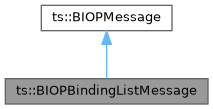
BIOP message whose body is a list of Bindings.
More...
#include <tsDSMCCBIOPMessage.h>
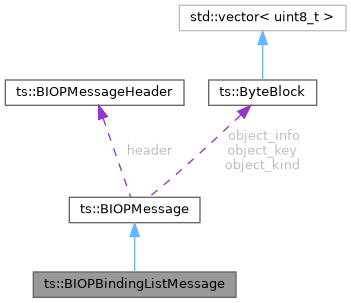
BIOP message whose body is a list of Bindings.
Used for both BIOP::Directory and BIOP::ServiceGateway — the wire format and XML schema are identical; the only difference is the object_kind tag, which is preserved on the base BIOPMessage::object_kind field. Callers that need to distinguish them check kindTag() against BIOPObjectKind::DIRECTORY or BIOPObjectKind::SERVICE_GATEWAY.
- See also
- ISO/IEC 13818-6 sections 8.6.3.1 and 8.6.3.2
◆ bindingList()
| virtual const std::vector< BIOPBinding > * ts::BIOPBindingListMessage::bindingList |
( |
| ) |
const |
|
inlineoverridevirtual |
Bindings carried by this message, if any.
- Returns
- Pointer to the bindings vector for Directory / ServiceGateway messages, nullptr for kinds that don't carry bindings.
Reimplemented from ts::BIOPMessage.
◆ deserializeBody()
| virtual bool ts::BIOPBindingListMessage::deserializeBody |
( |
PSIBuffer & |
buf | ) |
|
|
overrideprotectedvirtual |
Deserialize the subclass-specific message body.
- Parameters
-
| [in,out] | buf | Deserialization buffer. Exactly the body bytes are available. |
- Returns
- True on success.
Implements ts::BIOPMessage.
◆ toXMLBody()
Serialize the subclass-specific body to XML.
- Parameters
-
| [in,out] | duck | TSDuck execution context. |
| [in,out] | msg_element | The <BIOP_message> XML element to append body children to. |
Implements ts::BIOPMessage.
◆ fromXMLBody()
Deserialize the subclass-specific body from XML.
- Parameters
-
| [in,out] | duck | TSDuck execution context. |
| [in] | msg_element | The <BIOP_message> XML element containing the body. |
- Returns
- True on success.
Implements ts::BIOPMessage.
◆ kindTag()
| std::string ts::BIOPMessage::kindTag |
( |
| ) |
const |
|
inherited |
Get the object kind as a trimmed string (without the trailing null, if any).
- Returns
- Trimmed kind string.
◆ Parse()
Parse one BIOP message from a buffer.
Dispatches to the concrete subclass based on object_kind.
- Parameters
-
| [in,out] | buf | Deserialization buffer. |
- Returns
- Parsed message, or nullptr on error or unsupported kind.
◆ toXML()
This method converts a BIOPMessage to XML.
- Parameters
-
| [in,out] | duck | TSDuck execution context. |
| [in,out] | parent | The parent node for the XML element. |
◆ fromXML()
This method decodes an XML BIOPMessage.
- Parameters
-
| [in,out] | duck | TSDuck execution context. |
| [in] | element | The XML element containing the message. |
- Returns
- True on success, false on error.
◆ FromXML()
Parse a BIOP message from an XML element.
Dispatches to the concrete subclass based on the object_kind attribute.
- Parameters
-
| [in,out] | duck | TSDuck execution context. |
| [in] | element | The XML element to parse. |
- Returns
- Parsed message, or nullptr on error or unsupported kind.
◆ CreateForKind()
| static std::shared_ptr< BIOPMessage > ts::BIOPMessage::CreateForKind |
( |
const std::string & |
tag | ) |
|
|
staticprotectedinherited |
Construct a concrete BIOPMessage subclass for a given object_kind tag.
- Parameters
-
| [in] | tag | Trimmed object_kind string (e.g. "fil", "dir", "srg"). |
- Returns
- A new, empty subclass instance, or nullptr if the kind is unsupported.
The documentation for this class was generated from the following file:

 1.9.8
1.9.8