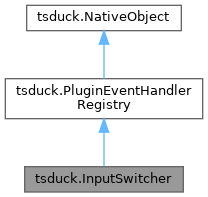
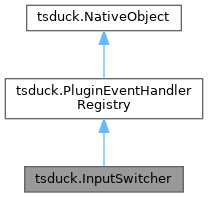
A wrapper class for C++ InputSwitcher.
More...
|
| | __init__ (self, report) |
| | Constructor.
|
| | currentInput (self) |
| | Get the index of the current input plugin.
|
| | delete (self) |
| | Explicitly free the underlying C++ object.
|
| | nextInput (self) |
| | Switch to the next input plugin.
|
| | previousInput (self) |
| | Switch to the previous input plugin.
|
| | registerEventHandler (self, handler, event_code) |
| | Register an event handler by event code.
|
| | registerInputEventHandler (self, handler) |
| | Register an event handler for all events from the input plugin.
|
| | registerOutputEventHandler (self, handler) |
| | Register an event handler for all events from the output plugin.
|
| | setInput (self, plugin_index) |
| | Switch to another input plugin.
|
| | start (self) |
| | Start the input switcher.
|
| | stop (self) |
| | Terminate the processing.
|
| | waitForTermination (self) |
| | Suspend the calling thread until input switcher session is completed.
|
|
|
str | app_name = "" |
| | Application name, for help messages.
|
|
int | buffered_packets = 0 |
| | Input buffer size in packets (0=default).
|
|
int | cycle_count = 1 |
| | Number of input cycles to execute (0 = infinite).
|
|
bool | delayed_switch = False |
| | Delayed switch between input plugins.
|
|
str | event_command = '' |
| | External shell command to run on a switching event.
|
|
str | event_local_address = '' |
| | Outgoing local interface for UDP event description.
|
|
int | event_ttl = 0 |
| | Time-to-live socket option for UDP event description.
|
|
str | event_udp_address = '' |
| | Remote IPv4 address or host name to receive switching event JSON description.
|
|
int | event_udp_port = 0 |
| | Remote UDP port to receive switching event JSON description.
|
|
bool | fast_switch = False |
| | Fast switch between input plugins.
|
|
int | first_input = 0 |
| | Index of first input plugin.
|
|
list | inputs = [] |
| | Input plugins name and arguments (list of lists of strings).
|
|
int | max_input_packets = 0 |
| | Maximum input packets to read at a time (0=default).
|
|
int | max_output_packets = 0 |
| | Maximum input packets to send at a time (0=default).
|
|
list | output = [] |
| | Output plugin name and arguments (list of strings).
|
|
int | primary_input = -1 |
| | Index of primary input plugin, negative if there is none.
|
|
int | receive_timeout = 0 |
| | Receive timeout before switch (0=none).
|
|
int | remote_server_port = 0 |
| | UDP server port for remote control (0=none).
|
|
bool | reuse_port = False |
| | Reuse-port socket option.
|
|
int | sock_buffer = 0 |
| | Socket buffer size (0=default).
|
|
bool | terminate = False |
| | Terminate when one input plugin completes.
|
A wrapper class for C++ InputSwitcher.
◆ __init__()
| tsduck.InputSwitcher.__init__ |
( |
| self, |
|
|
| report ) |
◆ delete()
| tsduck.InputSwitcher.delete |
( |
| self | ) |
|
Explicitly free the underlying C++ object.
After this call, the object becomes unusable. Most usages are unpredictable but most likely will do nothing.
- Returns
- None.
Reimplemented from tsduck.NativeObject.
◆ start()
| tsduck.InputSwitcher.start |
( |
| self | ) |
|
Start the input switcher.
All properties shall have been set before calling this method.
- Returns
- None.
◆ setInput()
| tsduck.InputSwitcher.setInput |
( |
| self, |
|
|
| plugin_index ) |
Switch to another input plugin.
- Parameters
-
| plugin_index | Index of the new input plugin. |
- Returns
- None.
◆ nextInput()
| tsduck.InputSwitcher.nextInput |
( |
| self | ) |
|
Switch to the next input plugin.
- Returns
- None.
◆ previousInput()
| tsduck.InputSwitcher.previousInput |
( |
| self | ) |
|
Switch to the previous input plugin.
- Returns
- None.
◆ currentInput()
| tsduck.InputSwitcher.currentInput |
( |
| self | ) |
|
Get the index of the current input plugin.
- Returns
- The index of the current input plugin.
◆ stop()
| tsduck.InputSwitcher.stop |
( |
| self | ) |
|
Terminate the processing.
- Returns
- None.
◆ waitForTermination()
| tsduck.InputSwitcher.waitForTermination |
( |
| self | ) |
|
Suspend the calling thread until input switcher session is completed.
- Returns
- None.
◆ registerEventHandler()
| tsduck.PluginEventHandlerRegistry.registerEventHandler |
( |
| self, |
|
|
| handler, |
|
|
| event_code ) |
|
inherited |
Register an event handler by event code.
- Parameters
-
- Returns
- None.
◆ registerInputEventHandler()
| tsduck.PluginEventHandlerRegistry.registerInputEventHandler |
( |
| self, |
|
|
| handler ) |
|
inherited |
Register an event handler for all events from the input plugin.
- Parameters
-
- Returns
- None.
◆ registerOutputEventHandler()
| tsduck.PluginEventHandlerRegistry.registerOutputEventHandler |
( |
| self, |
|
|
| handler ) |
|
inherited |
Register an event handler for all events from the output plugin.
- Parameters
-
- Returns
- None.
◆ _setNative()
| tsduck.NativeObject._setNative |
( |
| self, |
|
|
| obj ) |
|
protectedinherited |
Set the native object.
This is typically done by subclass constructors.
- Parameters
-
| obj | Address of the C++ native object to store. |
◆ _getNative()
| tsduck.NativeObject._getNative |
( |
| self | ) |
|
|
protectedinherited |
Get the native object.
This is typically used by subclasses.
- Returns
- Address of the C++ native object.
The documentation for this class was generated from the following file:

 1.15.0