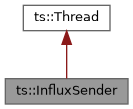
Asynchronously send requests to an InfluxDB server.
More...
#include <tsInfluxSender.h>
|
| static int | SilentLevel (bool silent, int default_severity=Severity::Error) |
| | Compute a log severity level from a "silent" parameter.
|
| |
|
| bool | start () |
| | Start the thread.
|
| |
Asynchronously send requests to an InfluxDB server.
We cannot anticipate the response time of the server. Using a thread avoid slowing down the packet transmission.
◆ InfluxSender()
| ts::InfluxSender::InfluxSender |
( |
Report * |
report | ) |
|
|
explicit |
Constructor.
- Parameters
-
| [in] | report | Where to report errors. The report object must remain valid as long as this object exists or setReport() is used with another Report object. If report is null, log messages are discarded. |
◆ start()
| bool ts::InfluxSender::start |
( |
const InfluxArgs & |
args | ) |
|
Start the asynchronous sender.
- Parameters
-
| [in] | args | Connection parameters to the InfluxDB server. |
- Returns
- True on success, false on error.
◆ stop()
| void ts::InfluxSender::stop |
( |
| ) |
|
Stop the asynchronous sender.
Wait for the internal thread to terminate.
◆ send()
Asynchronously send an InfluxDB request.
- Parameters
-
| [in,out] | request | Smart pointer to the request. The ownership of the pointer is transfered to the asynchronous sender. The parameter is nullified on return. |
- Returns
- True if the request was queued. False in case of queue overflow.
◆ report()
| virtual Report & ts::ReporterBase::report |
( |
| ) |
const |
|
overridevirtualinherited |
Access the Report which is associated with this object.
Can be called from another thread only if the Report object is thread-safe.
- Returns
- A reference to the associated report.
Implements ts::ReporterInterface.
◆ setReport() [1/2]
Associate this object with another Report to log errors.
- Parameters
-
| [in] | report | Where to report errors. The report object must remain valid as long as this object exists or setReport() is used with another Report object. If report is null, log messages are discarded. |
- Returns
- The address of the previous Report object or a null pointer if there was none.
◆ setReport() [2/2]
Associate this object with another ReporterBase to log errors.
- Parameters
-
| [in] | delegate | Use the report of another ReporterBase. If delegate is null, the previous explicit Report is used.. |
- Returns
- The address of the previous ReporterBase object or a null pointer if there was none.
◆ muteReport()
| bool ts::ReporterBase::muteReport |
( |
bool |
mute | ) |
|
|
inherited |
Temporarily mute the associated report.
- Parameters
-
| [in] | mute | It true, report() will return a null report (log messages are discarded), until muteReport() is invoked again with mute set to false. |
- Returns
- Previous state of the mute field.
◆ SilentLevel()
| static int ts::ReporterBase::SilentLevel |
( |
bool |
silent, |
|
|
int |
default_severity = Severity::Error |
|
) |
| |
|
inlinestaticinherited |
Compute a log severity level from a "silent" parameter.
Some subclass methods have a "silent" parameter to avoid reporting errors which may be insignificant, typically when closing a device after an error, in which case the close operation may produce other errors if the previous error left the device in an inconsistent state. While those errors should not be displayed as errors, we still display them at debug level.
- Parameters
-
| [in] | silent | If true, do not report errors, report debug messages instead. |
| [in] | default_severity | Default severity, in non-silent mode (error by default). |
- Returns
- Error when silent is false, Debug otherwise.
The documentation for this class was generated from the following file:

 1.9.8
1.9.8