 |
TSDuck v3.46-4840
MPEG Transport Stream Toolkit
|
|
TSDuck v3.46-4840
MPEG Transport Stream Toolkit
|
Read a pcap or pcapng file with packet filtering. More...
#include <tsPcapFilter.h>
Public Member Functions | |
| PcapFilter (Report *report) | |
| Constructor. | |
| PcapFilter (ReporterBase *delegate) | |
| Constructor. | |
| bool | addressFilterIsSet () const |
| Check if the address filter is precisely set. | |
| virtual void | clearProtocolFilter () |
| Clear the set of protocols to filter, all protocols are accepted. | |
| virtual void | close () |
| Close the file. | |
| void | defineArgs (Args &args) |
| Add command line option definitions in an Args. | |
| const IPSocketAddress & | destinationFilter () const |
| Get the current destination filter. | |
| bool | endOfFile () const |
| Check if the end of file (or other error) has been reached. | |
| fs::path | fileName () const |
| Get the file name. | |
| uint64_t | fileSize () const |
| Get the total file size in bytes so far. | |
| cn::microseconds | firstTimestamp () const |
| Get the capture timestamp of the first packet in the file. | |
| uint64_t | ipPacketCount () const |
| Get the number of valid captured IP packets so far. | |
| bool | isOpen () const |
| Check if the file is open. | |
| cn::microseconds | lastTimestamp () const |
| Get the capture timestamp of the last packet which was read from the file. | |
| bool | loadArgs (Args &args) |
| Load arguments from command line. | |
| bool | muteReport (bool mute) |
| Temporarily mute the associated report. | |
| virtual bool | open (const fs::path &filename) override |
| Open the file for read. | |
| const IPSocketAddress & | otherFilter (const IPSocketAddress &addr) const |
| Get the "other" filter (source or destination) based on the other one. | |
| uint64_t | packetCount () const |
| Get the number of captured packets so far. | |
| virtual bool | readIP (IPPacket &packet, VLANIdStack &vlans, cn::microseconds ×tamp) override |
| Read the next IP packet, IPv4 or IPv6, headers included. | |
| virtual Report & | report () const override |
| Access the Report which is associated with this object. | |
| virtual void | setBidirectionalFilter (const IPSocketAddress &addr1, const IPSocketAddress &addr2) |
| Set a bidirectional address filter. | |
| virtual void | setDestinationFilter (const IPSocketAddress &addr) |
| Set a destination address filter. | |
| void | setFirstPacketFilter (size_t count) |
| Filter packets starting at the specified number. | |
| void | setFirstTimeOffset (cn::microseconds time) |
| Filter packets starting at the specified time offset from the beginning of the file. | |
| void | setFirstTimestamp (cn::microseconds time) |
| Filter packets starting at the specified timestamp. | |
| void | setLastPacketFilter (size_t count) |
| Filter packets up to the specified number. | |
| void | setLastTimeOffset (cn::microseconds time) |
| Filter packets up to the specified time offset from the beginning of the file. | |
| void | setLastTimestamp (cn::microseconds time) |
| Filter packets up to the specified timestamp. | |
| virtual void | setProtocolFilter (const std::set< uint8_t > &protocols) |
| Filter packets with the specified set of protocols. | |
| virtual void | setProtocolFilterTCP () |
| Filter TCP packets only. | |
| virtual void | setProtocolFilterUDP () |
| Filter UDP packets only. | |
| Report * | setReport (Report *report) |
| Associate this object with another Report to log errors. | |
| ReporterBase * | setReport (ReporterBase *delegate) |
| Associate this object with another ReporterBase to log errors. | |
| void | setReportAddressesFilterSeverity (int level) |
| Specify the severity to report the filtered addresses once (in non-wildcard mode). | |
| virtual void | setSourceFilter (const IPSocketAddress &addr) |
| Set a source address filter. | |
| virtual void | setWildcardFilter (bool on) |
| Set the source and destination address filter in wildcard mode. | |
| const IPSocketAddress & | sourceFilter () const |
| Get the current source filter. | |
| cn::microseconds | timeOffset (cn::microseconds timestamp) const |
| Compute the time offset from the beginning of the file of a packet timestamp. | |
| uint64_t | totalIPPacketsSize () const |
| Get the total size in bytes of valid captured IP packets so far. | |
| uint64_t | totalPacketsSize () const |
| Get the total size in bytes of captured packets so far. | |
Static Public Member Functions | |
| static int | SilentLevel (bool silent, int default_severity=Severity::Error) |
| Compute a log severity level from a "silent" parameter. | |
| static Time | ToTime (cn::microseconds timestamp) |
| Compute the date and time from a packet timestamp. | |
Read a pcap or pcapng file with packet filtering.
This class also sets filtering options from the command line: --first-packet, --first-timestamp, --first-date, --last-packet, --last-timestamp, --last-date.
|
inlineexplicit |
Constructor.
| [in] | report | Where to report errors. The report object must remain valid as long as this object exists or setReport() is used with another Report object. If report is null, log messages are discarded. |
|
inlineexplicit |
Constructor.
| [in] | delegate | Use the report of another ReporterBase. If delegate is null, log messages are discarded. |
|
inline |
Filter packets starting at the specified number.
The packet numbering counts all captured packets from the beginning of the file, starting at 1. This is the same value as seen on Wireshark in the leftmost column.
| [in] | count | Number of first captured packet to read. |
|
inline |
Filter packets up to the specified number.
The packet numbering counts all captured packets from the beginning of the file, starting at 1. This is the same value as seen on Wireshark in the leftmost column.
| [in] | count | Number of last captured packet to read. |
|
inline |
Filter packets starting at the specified time offset from the beginning of the file.
This is the same value as seen on Wireshark in the "Time" column (in seconds).
| [in] | time | First time offset in microseconds from the beginning of the capture. |
|
inline |
Filter packets up to the specified time offset from the beginning of the file.
This is the same value as seen on Wireshark in the "Time" column (in seconds).
| [in] | time | Last time offset in microseconds from the beginning of the capture. |
|
inline |
Filter packets starting at the specified timestamp.
| [in] | time | First timestamp, in microseconds from the UNIX epoch. |
|
inline |
Filter packets up to the specified timestamp.
| [in] | time | Last timestamp, in microseconds from the UNIX epoch. |
|
virtual |
Filter packets with the specified set of protocols.
| [in] | protocols | A set of 8-bit protocol values (eg. IPv4_PROTO_TCP, IPv4_PROTO_ICMP, etc.) If the filter is empty, all packets are passed (same as all protocol values set). |
|
virtual |
Set a source address filter.
| [in] | addr | Source address to filter. The port is meaningful only with TCP and UDP. |
|
virtual |
Set a destination address filter.
| [in] | addr | Destination address to filter. The port is meaningful only with TCP and UDP. |
|
virtual |
Set a bidirectional address filter.
Select packets where the source and destination addresses match the pair of filtered address, in any direction.
| [in] | addr1 | First address to filter, either source or destination. The port is meaningful only with TCP and UDP. |
| [in] | addr2 | Second address to filter, either source or destination. The port is meaningful only with TCP and UDP. |
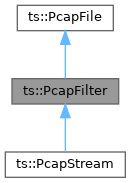
Reimplemented in ts::PcapStream.
|
inline |
Get the current source filter.
In the case of non-wildcard filtering, after returning the first packet, this is the actual socket address of the filtered stream.
In the case of bidirectional filtering (for instance a TCP session), there is no real "source" or "destination". They are the two endpoints of the stream.
|
inline |
Get the current destination filter.
In the case of non-wildcard filtering, after returning the first packet, this is the actual socket address of the filtered stream.
In the case of bidirectional filtering (for instance a TCP session), there is no real "source" or "destination". They are the two endpoints of the stream.
|
virtual |
Set the source and destination address filter in wildcard mode.
When the address filter is in wildcard mode (the default), the unspecified parts of source and destination, address or port, act as wildcard for all packets.
When the wildcard mode is set to false, the first packet which matches the unspecified parts forces the addresses of that packet. In other words, the first packet which matches the wildcard forces a specific stream and all subsequent packets are filtered for that specific stream.
| [in] | on | If true, use wildcard mode for all packets. If false, the first packet which matches the wildcard forces a specific stream. |
| bool ts::PcapFilter::addressFilterIsSet | ( | ) | const |
Check if the address filter is precisely set.
Using address filtering, some addresses or port may be unspecified, acting as a wildcard. In non-wildcard mode, the first packet matching this wildcard is selected and the corresponding stream is then exclusively filtered. At this point, the filter is precisely set.
| const IPSocketAddress & ts::PcapFilter::otherFilter | ( | const IPSocketAddress & | addr | ) | const |
Get the "other" filter (source or destination) based on the other one.
| [in] | addr | A socket address, typically matching the source or destination filter. |
|
inline |
Specify the severity to report the filtered addresses once (in non-wildcard mode).
In non-wildcard mode, when the filtered addresses contain non-specified fields, the first packet which matches the filters define the stream. At this point, the selected stream is displayed (in debug mode by default). This function redefines the severity level (info or verbose for instance).
| [in] | level | Severity level to use. |
| void ts::PcapFilter::defineArgs | ( | Args & | args | ) |
Add command line option definitions in an Args.
| [in,out] | args | Command line arguments to update. |
| bool ts::PcapFilter::loadArgs | ( | Args & | args | ) |
Load arguments from command line.
Args error indicator is set in case of incorrect arguments.
| [in,out] | args | Command line arguments. |
|
overridevirtual |
Open the file for read.
| [in] | filename | File name. If empty or "-", use standard input. |
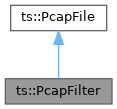
Reimplemented from ts::PcapFile.
Reimplemented in ts::PcapStream.
|
overridevirtual |
Read the next IP packet, IPv4 or IPv6, headers included.
Skip intermediate metadata and other types of packets.
| [out] | packet | Received IP packet. |
| [out] | vlans | Stack of VLAN encapsulation from which the packet is extracted. |
| [out] | timestamp | Capture timestamp in microseconds since Unix epoch or -1 if none is available. |
Reimplemented from ts::PcapFile.
|
inlineinherited |
Check if the file is open.
|
inlineinherited |
Get the file name.
|
inlineinherited |
Get the number of captured packets so far.
This includes all packets, not only IP packets. This value is the number of the last returned packet, as seen in the left-most column in Wireshark interface.
|
inlineinherited |
Check if the end of file (or other error) has been reached.
|
inlineinherited |
Get the number of valid captured IP packets so far.
|
inlineinherited |
Get the total file size in bytes so far.
|
inlineinherited |
Get the total size in bytes of captured packets so far.
This includes all packets, including link-layer headers when present.
|
inlineinherited |
Get the total size in bytes of valid captured IP packets so far.
This includes all IP headers but not link-layer headers when present.
|
inlineinherited |
Get the capture timestamp of the first packet in the file.
|
inlineinherited |
Get the capture timestamp of the last packet which was read from the file.
|
inlineinherited |
Compute the time offset from the beginning of the file of a packet timestamp.
| [in] | timestamp | Capture timestamp of a packet in the file. |
|
inlinestaticinherited |
Compute the date and time from a packet timestamp.
| [in] | timestamp | Capture timestamp of a packet in a file. |
|
virtualinherited |
Close the file.
Do not reset counters, file names, etc. The last values before close() are still accessible.
|
overridevirtualinherited |
Access the Report which is associated with this object.
Can be called from another thread only if the Report object is thread-safe.
Implements ts::ReporterInterface.
Associate this object with another Report to log errors.
| [in] | report | Where to report errors. The report object must remain valid as long as this object exists or setReport() is used with another Report object. If report is null, log messages are discarded. |
|
inherited |
Associate this object with another ReporterBase to log errors.
| [in] | delegate | Use the report of another ReporterBase. If delegate is null, the previous explicit Report is used.. |
|
inherited |
Temporarily mute the associated report.
| [in] | mute | It true, report() will return a null report (log messages are discarded), until muteReport() is invoked again with mute set to false. |
|
inlinestaticinherited |
Compute a log severity level from a "silent" parameter.
Some subclass methods have a "silent" parameter to avoid reporting errors which may be insignificant, typically when closing a device after an error, in which case the close operation may produce other errors if the previous error left the device in an inconsistent state. While those errors should not be displayed as errors, we still display them at debug level.
| [in] | silent | If true, do not report errors, report debug messages instead. |
| [in] | default_severity | Default severity, in non-silent mode (error by default). |
 1.9.8
1.9.8