 |
TSDuck v3.46-4840
MPEG Transport Stream Toolkit
|
|
TSDuck v3.46-4840
MPEG Transport Stream Toolkit
|
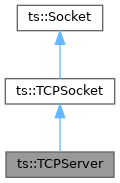
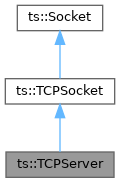
Implementation of a TCP/IP server. More...
#include <tsTCPServer.h>
Public Types | |
| using | SuperClass = TCPSocket |
| Reference to the superclass. | |
Public Member Functions | |
| TCPServer (Report *report, bool non_blocking=false) | |
| Constructor. | |
| TCPServer (ReporterBase *delegate, bool non_blocking=false) | |
| Constructor. | |
| virtual bool | accept (TCPConnection &client, IPSocketAddress &client_address, IOSB *iosb=nullptr) |
| Wait for an incoming client connection. | |
| void | addSubscription (SubscriptionHandlerInterface *handler) |
| Add a subscriber to open/close events. | |
| bool | bind (const IPSocketAddress &addr) |
| Bind to a local address and port. | |
| void | cancelSubscription (SubscriptionHandlerInterface *handler) |
| Remove a subscriber to open/close events. | |
| virtual bool | close (bool silent=false) final |
| Close the socket. | |
| IP | generation () const |
| Get the IP generation with which the socket was open. | |
| SysHandleType | getHandle () const |
| Get the underlying file descriptor or device handle. | |
| bool | getLocalAddress (IPSocketAddress &addr) const |
| Get local socket address. | |
| virtual SysHandleType | getReadHandle () const override |
| Get the underlying file descriptor or device handle for read operations. | |
| SysSocketType | getReadSocket () const |
| Get the underlying file descriptor or device handle as a system socket handle for read operations. | |
| SysSocketType | getSocket () const |
| Get the underlying file descriptor or device handle as a system socket handle. | |
| virtual SysHandleType | getWriteHandle () const override |
| Get the underlying file descriptor or device handle for write operations. | |
| SysSocketType | getWriteSocket () const |
| Get the underlying file descriptor or device handle as a system socket handle for write operations. | |
| bool | isNonBlocking () const |
| Check if the device is in non-blocking mode. | |
| bool | isOpen () const |
| Check if socket is open. | |
| bool | isSupportedByReactor (bool recheck=false) |
| Check if the device is supported by a reactor for non-blocking or asynchronous I/O. | |
| virtual bool | listen (int backlog) |
| Start the server. | |
| UString | localName () |
| Get the local address as a string. | |
| bool | muteReport (bool mute) |
| Temporarily mute the associated report. | |
| virtual bool | open (IP gen=IP::Any) final |
| Open the socket. | |
| virtual Report & | report () const override |
| Access the Report which is associated with this object. | |
| bool | reusePort (bool reuse_port) |
| Set the "reuse port" option. | |
| bool | setAcceptStatus (TCPConnection &client, IPSocketAddress &client_address, IOSB *iosb) |
| Update the status of an asynchronous accept(). | |
| bool | setKeepAlive (bool active) |
| Set the "keep alive" option. | |
| bool | setLingerTime (int seconds) |
| Set the linger time option. | |
| bool | setNoDelay (bool active) |
| Set the "no delay" option. | |
| bool | setNoLinger () |
| Remove the linger time option. | |
| bool | setNonBlocking (bool non_blocking) |
| Set the device in non-blocking mode. | |
| bool | setReceiveBufferSize (size_t size) |
| Set the receive buffer size. | |
| bool | setReceiveTimeout (cn::milliseconds timeout) |
| Set the receive timeout. | |
| Report * | setReport (Report *report) |
| Associate this object with another Report to log errors. | |
| ReporterBase * | setReport (ReporterBase *delegate) |
| Associate this object with another ReporterBase to log errors. | |
| bool | setSendBufferSize (size_t size) |
| Set the send buffer size. | |
| bool | setTTL (int ttl) |
| Set the Time To Live (TTL) option. | |
Static Public Member Functions | |
| static bool | IsPendingStatus (int error_code) |
| This static method checks if a system error code means "I/O in progress" (asynchronous I/O) or "I/O would block" (non-blocking I/O). | |
| static int | SilentLevel (bool silent, int default_severity=Severity::Error) |
| Compute a log severity level from a "silent" parameter. | |
Static Public Attributes | |
| static constexpr size_t | DEFAULT_RECEIVE_BUFFER_SIZE = 16 * 1024 |
| Default buffer size for receive operations. | |
Protected Member Functions | |
| virtual bool | allowSetNonBlocking () const override |
| Check that the non-blocking mode can be set. | |
| template<typename HANDLER , typename F > requires std::derived_from<HANDLER, SubscriptionHandlerInterface> | |
| void | callSubscribers (F &&func) |
| Call a handler on all subscribers, using a lambda expression. | |
| bool | checkNonBlocking (bool non_blocking, const UChar *opname) |
| Check the blocking mode of a device. | |
| bool | checkNonBlocking (IOSB *iosb, const UChar *opname) |
| Check the blocking mode of a device. | |
| virtual bool | closeImplementation (bool silent) override |
| Close the socket, actual implementation which may be overriden by subclasses. | |
| bool | convert (IPAddress &addr) const |
| Convert an IP address to make it compatible with the socket IP generation. | |
| bool | createSocket (IP gen, int type, int protocol) |
| Create the socket. | |
| virtual void | declareOpened (SysSocketType sock) override |
| Set an open socket descriptor from a subclass. | |
| int | genericSystemRead (void *addr, size_t max_size, size_t &ret_size, const AbortInterface *abort, Device::IOSB *iosb, uint64_t position) |
| Generic system read operation. | |
| int | genericSystemWrite (const void *addr, size_t size, size_t &written_size, Device::IOSB *iosb, uint64_t position) |
| Generic system write operation. | |
| virtual bool | openImplementation (IP gen) override |
| Open the socket, actual implementation which must be overriden by subclasses. | |
| bool | setSystemNonBlocking (bool non_blocking) |
| Low-level method to set the system file or socket descriptor in non-blocking mode. | |
Protected Attributes | |
| std::recursive_mutex | _mutex {} |
| Mutex protecting this object. | |
Implementation of a TCP/IP server.
The following lists the typical server-side scenario in the correct order. Many steps such as setting socket options are optional. The symbol [*] means mandatory. Depending on the platform, some options settings are sensitive to the order. The following order has proven to work on most platforms.
Invoking close() is optional since the destructor of the class will properly close the socket if not already done.
|
inlineexplicit |
Constructor.
| [in] | report | Where to report errors. The report object must remain valid as long as this object exists or setReport() is used with another Report object. If report is null, log messages are discarded. |
| [in] | non_blocking | It true, the device is initially set in non-blocking mode. |
|
inlineexplicit |
Constructor.
| [in] | delegate | Use the report of another ReporterBase. If delegate is null, log messages are discarded. |
| [in] | non_blocking | It true, the device is initially set in non-blocking mode. |
|
virtual |
Start the server.
Here, starting the server means starting to listen to incoming client connections. Internally to the kernel, the incoming connections are queued up to backlog. When the method accept() is invoked and some incoming connections are already queued in the kernel, the oldest one is immediately accepted. Otherwise, accept() blocks until a new incoming connection arrives.
| [in] | backlog | Maximum number of incoming connections which allowed to queue in the kernel until the next call to accept(). Note that this value is a minimum queue size. But the kernel may accept more. There is no guarantee that additional incoming connections will be rejected if more than backlog are already queueing. |
Reimplemented in ts::TLSServer.
|
virtual |
Wait for an incoming client connection.
| [out] | client | This object receives the new connection. Upon successful return from accept(), the TCPConnection object is a properly connected TCP session. Once the connection is completed, the TCPConnection objects on the client side and the server side are symmetric and can be used the same way. In case of asynchronous I/O, the object must remain valid until the accept() completes or is canceled. |
| [out] | client_address | This object receives the socket address of the client. If the server wants to filter client connections based on their IP address, it may use addr for that. |
| [in,out] | iosb | Address of an IOSB structure. If non-null, the socket must be in non-blocking mode. When null, the socket must be in blocking mode (the default). See the description of IOSB. Important: The parameter iosb should not be used by applications. It should be used only by "reactive classes", which work in combination with a Reactor. |
Reimplemented in ts::TLSServer.
| bool ts::TCPServer::setAcceptStatus | ( | TCPConnection & | client, |
| IPSocketAddress & | client_address, | ||
| IOSB * | iosb | ||
| ) |
Update the status of an asynchronous accept().
This method shall be used with asynchronous I/O only. It returns an error when the system uses non-blocking I/O instead of asynchronous I/O.
| [in,out] | client | The socket which received the new connection. |
| [out] | client_address | This object receives the socket address of the client. |
| [in,out] | iosb | Address of the IOSB structure which was used when connect() was called. |
|
overrideprotectedvirtual |
Close the socket, actual implementation which may be overriden by subclasses.
Never called when the application tries to close a socket which is not open. If overridden by a subclass, the superclass must be called at the end of the overridden close().
| [in] | silent | If true, do not report errors through the logger. This is typically useful when the socket is in some error condition and closing it is necessary although it may generate additional meaningless errors. |
Reimplemented from ts::TCPSocket.
Reimplemented in ts::TLSServer.
|
inherited |
Set the Time To Live (TTL) option.
| [in] | ttl | The TTL value, ie. the maximum number of "hops" between routers before an IP packet is dropped. |
|
inherited |
Remove the linger time option.
|
inherited |
Set the linger time option.
| [in] | seconds | Number of seconds to wait after shuting down the socket. |
|
inherited |
Set the "keep alive" option.
| [in] | active | If true, the socket periodically sends "keep alive" packets when the connection is idle. |
|
inherited |
Set the "no delay" option.
| [in] | active | If true, the socket immediately sends outgoing packets. By default, a TCP socket waits a small amount of time after a send() operation to get a chance to group outgoing data from successive send() operations into one single packet. |
|
overrideprotectedvirtualinherited |
Open the socket, actual implementation which must be overriden by subclasses.
Never called when the application tries to open a socket which is already open.
| [in] | gen | IP generation, IPv4 or IPv6. If set to IP::Any, open an IPv6 socket (IPv4 connections allowed). |
Implements ts::Socket.
|
overrideprotectedvirtualinherited |
Set an open socket descriptor from a subclass.
This method is used by a server to declare that a client socket has just become opened.
| [in] | sock | New socket descriptor. |
Reimplemented from ts::Socket.
Open the socket.
Subclasses are not permitted to override this one, they should implement openImplementation().
| [in] | gen | IP generation, IPv4 or IPv6. If set to IP::Any, open an IPv6 socket (IPv4 connections allowed). |
|
finalvirtualinherited |
Close the socket.
Subclasses are not permitted to override this one, they should implement closeImplementation().
| [in] | silent | If true, do not report errors through the logger. This is typically useful when the socket is in some error condition and closing it is necessary although it may generate additional meaningless errors. |
|
inlineinherited |
Check if socket is open.
|
inlineinherited |
Get the IP generation with which the socket was open.
|
inherited |
Set the send buffer size.
| [in] | size | Send buffer size in bytes. |
|
inherited |
Set the receive buffer size.
| [in] | size | Receive buffer size in bytes. |
|
inherited |
Set the receive timeout.
| [in] | timeout | Receive timeout in milliseconds. If negative or zero, receive timeout is not used, reception waits forever. |
|
inherited |
Set the "reuse port" option.
| [in] | reuse_port | If true, the socket is allowed to reuse a local UDP port which is already bound. |
|
inherited |
Bind to a local address and port.
The IP address part of the socket address must one of:
Special note for receiving multicast on most Unix systems (at least Linux and macOS): The IP address shall be either AnyAddress4 or the multicast group address. Do not specify a local address to receive multicast on Unix.
The port number part of the socket address must be one of:
| [in] | addr | Local socket address to bind to. |
|
inherited |
Get local socket address.
| [out] | addr | Local socket address of the connection. |
|
inherited |
Get the local address as a string.
|
overridevirtualinherited |
Get the underlying file descriptor or device handle for read operations.
Subclasses should override this method.
Reimplemented from ts::Device.
|
overridevirtualinherited |
Get the underlying file descriptor or device handle for write operations.
Subclasses should override this method.
Reimplemented from ts::Device.
|
protectedinherited |
|
protectedinherited |
Convert an IP address to make it compatible with the socket IP generation.
| addr | [in,out] The address to convert. |
|
overrideprotectedvirtualinherited |
Check that the non-blocking mode can be set.
Must be implemented by subclasses which do not support setting the non-blocking in certain states, such as after being opened. The default implementation always allows setting the non-blocking mode.
Reimplemented from ts::Device.
|
inherited |
Set the device in non-blocking mode.
Important: Usually, this method must be called before opening the device, whatever it means. Otherwise it is ignored and the device blocking mode is unchanged.
| [in] | non_blocking | It true, the device is set in non-blocking mode. |
|
inlineinherited |
Check if the device is in non-blocking mode.
|
inherited |
Check if the device is supported by a reactor for non-blocking or asynchronous I/O.
| [in] | recheck | If true, force a recheck. If false and the device was previously checked, return the previous cached value. |
|
inlinestaticinherited |
This static method checks if a system error code means "I/O in progress" (asynchronous I/O) or "I/O would block" (non-blocking I/O).
| [in] | error_code | System error code. |
|
inherited |
Get the underlying file descriptor or device handle.
This method is reserved for low-level operations and should not be used by normal applications.
On UNIX systems, sockets are standard file descriptors. On Windows systems, sockets and devices handles are two distinct types (SOCKET, an integer type, and HANDLE, a pointer type). However, SOCKET and HANDLE have the same size and can be converted between each other. In practice, all Windows device handles are pointers. When Microsoft decided to implement the BSD socket API, they needed to represent sockets as integers. The integer is simply a cast of the HANDLE pointer.
In practice, the methods getHandle() and getSocket() return the same value, represented as two different portable types, SysHandleType and SysSocketType. Note that this types are defined as their real representation. On UNIX systems, both are defined as int and are compatible. However, on Windows systems, they are defined as HANDLE and SOCKET and are not compatible. So, accidentally mixing the two compiles on UNIX but not on Windows. Be careful to use the right type for the right usage.
There is one important difference between getHandle() and getSocket(): the error values, SYS_HANDLE_INVALID and SYS_SOCKET_INVALID. Be careful, these constants have distinct binary values on Windows. This is the only case were it is not possible to cast between a SysHandleType value and a SysSocketType value. This is why it is recommended to always use getHandle() when a SysHandleType is required and getSocket() when a SysSocketType is required.
A subclass which uses file descriptors or device handles for read, write, or both, must override the methods getReadHandle(), getWriteHandle(), or both. If the two types of operations use the same file descriptor, the two methods must return the same value.
An application should call getReadHandle() for read operations and getWriteHandle() for write operations. The method getHandle() returns getReadHandle() if its returns a valid value, and getWriteHandle() otherwise.
|
inherited |
Get the underlying file descriptor or device handle as a system socket handle.
|
inherited |
Get the underlying file descriptor or device handle as a system socket handle for read operations.
|
inherited |
Get the underlying file descriptor or device handle as a system socket handle for write operations.
|
protectedinherited |
Check the blocking mode of a device.
Called by subclass methods which are explicitly called in blocking or non-blocking mode.
| [in] | non_blocking | The required non-blocking mode. |
| [in] | opname | Name of the operation, for the error message. |
Check the blocking mode of a device.
Called by subclass methods which are explicitly called in blocking or non-blocking mode.
| [in,out] | iosb | Address of an IOSB structure. If non-null, we are in non-blocking mode. When null, we are in blocking mode. When non-null, pending is reset to false and overlap is zeroed. |
| [in] | opname | Name of the operation, for the error message. |
|
protectedinherited |
Low-level method to set the system file or socket descriptor in non-blocking mode.
| [in] | non_blocking | It true, the device is set in non-blocking mode. |
Summary: Do not use this method unless you exactly know what you are doing.
UNIX: Depending on the way a file descriptor is created, it may be possible to specify the non-blocking mode from the beginning. Or it can be somehow inherited. However, this is not portable.
Examples:
In all cases, it is possible to set a file descriptor in non-blocking mode at any time using the method setSystemNonBlocking(). This method uses fcntl(F_SETFL) to alter the file descriptor's flags.
Windows: The natural way of not being blocked on I/O on Windows is asynchronous I/O. To increase the general confusion, there is some form of non-blocking mode on Windows sockets, and only sockets, not other forms of file handles. This mode is activated using "ioctlsocket(fd, FIONBIO, &mode)". When this mode is active, socket I/O become similar to UNIX: they immediately either succeed or fail, but never block. However, there is no way to get notified when the I/O becomes possible. There is no equivalent to epoll (Linux) or kqueue (macOS and BSD). The Windows I/O Completion Ports can only work on asynchronous I/O, using OVERLAPPED structures. Because this form of non-blocking mode is mostly useless in practice, we do not use it and the method setSystemNonBlocking() does nothing on Windows.
|
protectedinherited |
Generic system write operation.
This is a convenience method which can be used (or not) by subclasses when the system calls write() (UNIX) or WriteFile() (Windows) are appropriate.
| [in] | addr | Address of the data to write. |
| [in] | size | Size in bytes of the data to write. |
| [out] | written_size | Actually written size in bytes. Can be less than size in case of error in the middle of the write. |
| [in,out] | iosb | Address of an IOSB structure. If non-null, the stream must be in non-blocking mode. When null, the stream must be in blocking mode (the default). See the description of ts::Device::IOSB. |
| [in] | position | This value is only used on Windows with asynchronous I/O on disk file. On Windows, when asynchronous I/O are used on random access files, the file position is not maintained. Each read or write operation is performed at the specified absolute position. |
|
protectedinherited |
Generic system read operation.
This is a convenience method which can be used (or not) by subclasses when the system calls read() (UNIX) or ReadFile() (Windows) are appropriate.
| [out] | addr | Address of the buffer for the incoming data. |
| [in] | max_size | Maximum size in bytes of the buffer. |
| [out] | ret_size | Returned input size in bytes. If zero, end of file has been reached or an error occurred. |
| [in] | abort | If non-zero, invoked when I/O is interrupted (in case of user-interrupt, return, otherwise retry). |
| [in,out] | iosb | Address of an IOSB structure. If non-null, the stream must be in non-blocking mode. When null, the stream must be in blocking mode (the default). See the description of ts::Device::IOSB. |
| [in] | position | This value is only used on Windows with asynchronous I/O on disk file. On Windows, when asynchronous I/O are used on random access files, the file position is not maintained. Each read or write operation is performed at the specified absolute position. |
|
overridevirtualinherited |
Access the Report which is associated with this object.
Can be called from another thread only if the Report object is thread-safe.
Implements ts::ReporterInterface.
Associate this object with another Report to log errors.
| [in] | report | Where to report errors. The report object must remain valid as long as this object exists or setReport() is used with another Report object. If report is null, log messages are discarded. |
|
inherited |
Associate this object with another ReporterBase to log errors.
| [in] | delegate | Use the report of another ReporterBase. If delegate is null, the previous explicit Report is used.. |
|
inherited |
Temporarily mute the associated report.
| [in] | mute | It true, report() will return a null report (log messages are discarded), until muteReport() is invoked again with mute set to false. |
|
inlinestaticinherited |
Compute a log severity level from a "silent" parameter.
Some subclass methods have a "silent" parameter to avoid reporting errors which may be insignificant, typically when closing a device after an error, in which case the close operation may produce other errors if the previous error left the device in an inconsistent state. While those errors should not be displayed as errors, we still display them at debug level.
| [in] | silent | If true, do not report errors, report debug messages instead. |
| [in] | default_severity | Default severity, in non-silent mode (error by default). |
|
inherited |
|
inherited |
|
inlineprotectedinherited |
Call a handler on all subscribers, using a lambda expression.
| [in] | func | Function to call as lambda expression. |
|
staticconstexprinherited |
Default buffer size for receive operations.
This constant is used as default value in several I/O classes.
 1.9.8
1.9.8